Modern campus networks need to support multiple services at the same time, including office access, server room operations, video surveillance, wireless access, voice communication, IoT device access, and guest networks. Traditional flat Layer 2 networks are increasingly unable to meet long-term requirements for reliability, security isolation, service expansion, and operations management. As a result, enterprises need a high-speed, stable, secure, multi-service, easy-to-operate, and scalable LAN infrastructure.
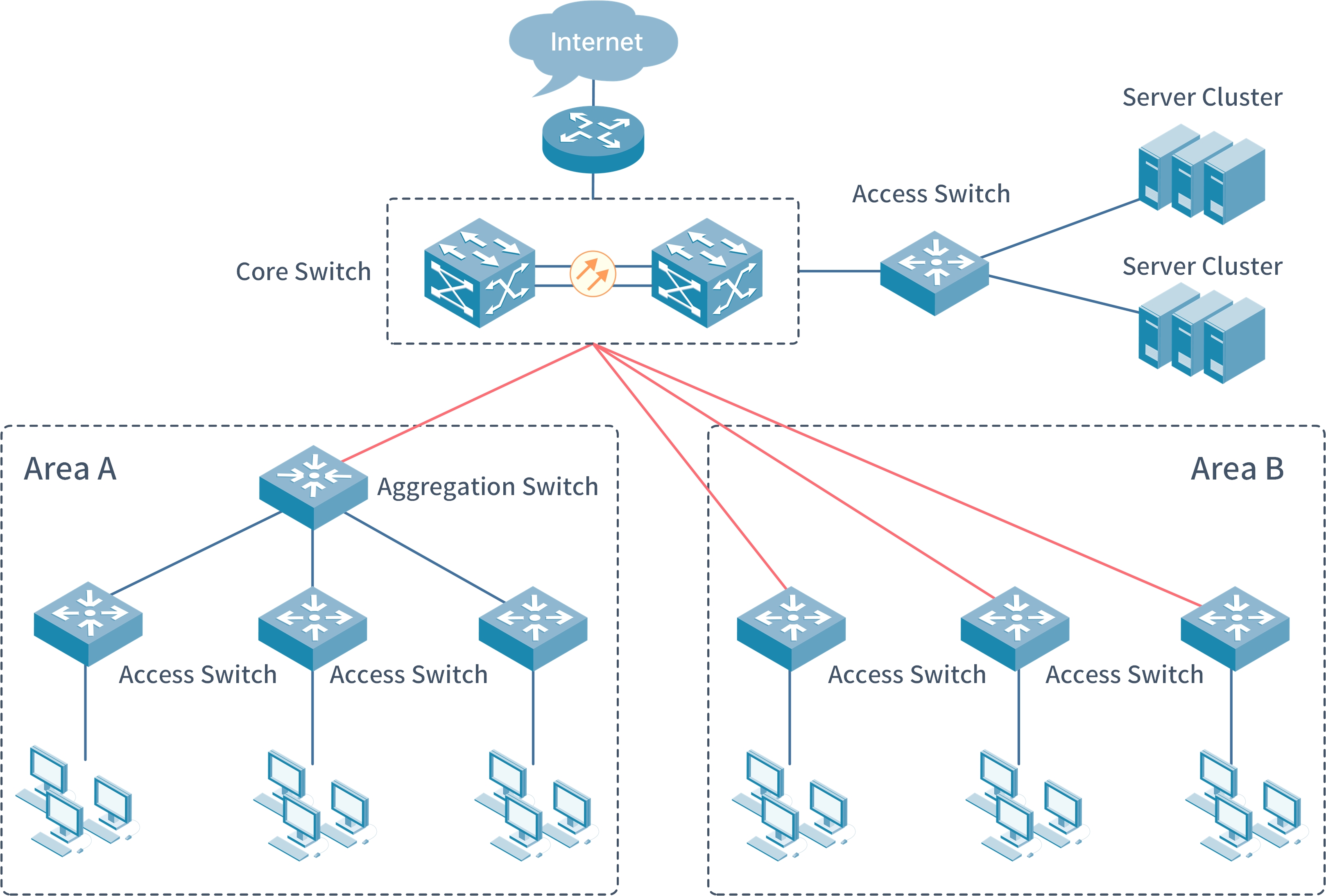
Sino-Telecom campus network solution is designed for campus network deployment scenarios, covering five key areas: office areas, server rooms, surveillance areas, IoT device areas, and guest access areas. The network adopts an all-optical Ethernet switching architecture and uses a three-layer design consisting of the core layer, aggregation layer, and access layer to achieve high-speed interconnection, unified management, and service isolation.
Why Enterprises Need a Next-Generation Campus Network Solution
With more services and devices running on the campus network, reliability, security, scalability, and O&M efficiency have become critical challenges:
High risk of service interruption: Office access, voice, surveillance, server room services, and IoT applications all depend on continuous network connectivity. Any failure in core devices or key links may affect multiple business systems.
Complex security isolation requirements: Office users, guests, cameras, IoT devices, and server room resources require different access permissions. Without clear isolation, the network may face unauthorized access and lateral movement risks.
Heavy deployment and O&M workload: Multiple access areas and a large number of devices make deployment and daily maintenance more complex, especially when the network architecture is unclear or device configuration is complicated.
Growing pressure for expansion: The continuous increase of terminals, APs, cameras, and IoT devices places pressure on port capacity, uplink bandwidth, and overall network scalability.
Cost control pressure: The customer needs to meet performance and reliability requirements while avoiding over-provisioning and unnecessary investment.
How the Sino-Telecom Campus Network Solution Works
Designed for campus networking scenarios, Sino-Telecom campus network solution is based on a core-aggregation-access architecture. By introducing a layered network design, it simplifies network planning, improves service traffic scheduling, strengthens access and security control, and supports smooth expansion as campus services continue to grow.
|
Network Layer
|
Core Functions
|
Requirement Mapping
|
|
Core Layer
|
Serves as the data forwarding core of the entire network, responsible for service aggregation, redundancy backup, and connection to aggregation devices and egress devices such as routers and firewalls
|
High speed, stability, high reliability, multi-service integration
|
|
Aggregation Layer
|
Aggregates access-layer devices, performs traffic forwarding, rate limiting, VLAN division, security control, and QoS scheduling
|
Security control, permission isolation, service scheduling
|
|
Access Layer
|
Provides access, PoE power supply, and basic access security for terminals such as PCs, APs, cameras, IP phones, and IoT devices
|
High-density access, PoE power supply, access security
|
Sino-Telecom SR3100 Series switches are positioned at the access layer to deliver high-performance, high-capacity switching for campus endpoints. With GE and 10GE uplink capabilities, they provide reliable bandwidth for office users, wireless APs, surveillance cameras, IP phones, and IoT devices.
SR3300/SR3600 Series switches are deployed at the core, aggregation, and high-performance access layers to create a resilient campus network foundation. With device virtualization, multiple switches can be managed and operated as one logical system, simplifying network design, service provisioning, and daily operations while enhancing reliability and forwarding performance.
Key Technical Advantages of the Sino-Telecom Campus Network Solution
High-Performance Access and Uplink Capacity
This solution supports gigabit access ports and GE/10GE uplinks deliver stable bandwidth for office users, wireless APs, IP phones, surveillance cameras, and IoT devices. This design supports unified service access and efficient traffic forwarding from the access layer to the aggregation layer.
Reliable Network Protection
Redundancy mechanisms such as STP/RSTP/MSTP, VRRP, ring protection, dual-uplink protection, and LACP link aggregation help improve network resilience. With BFD-based fast fault detection, link or device failures can be identified quickly to support rapid service recovery.
Comprehensive Security Control
Built-in security capabilities, including 802.1X authentication, MAC authentication, port security, ACLs, VLAN isolation, and user privilege management, help prevent unauthorized access, broadcast storms, DoS attacks, and abnormal traffic.
Advanced Service and QoS Capabilities
L2 to L4 packet filtering, traffic classification, rate limiting, port mirroring, and flexible queue scheduling allow critical services such as voice, video conferencing, and surveillance traffic to be prioritized in multi-service campus scenarios.
IPv6-Ready Architecture
Comprehensive IPv6 capabilities, including IPv6-based management, access control, multicast, DHCPv6, MLD, RIPng, OSPFv3 and BGP4+ features, provide a solid foundation for future IPv6 service evolution.
Simplified and Secure O&M
Multiple management and monitoring methods, including CLI, Web management, SNMP, Telnet, SSH, Console access, and traffic mirroring, make daily operations, fault diagnosis, and network optimization more efficient.
Green and Energy-Efficient Design
Efficient power conversion, intelligent power monitoring, flexible AC/DC/HVDC power options, and IEEE 802.3az Energy Efficient Ethernet support help reduce power consumption and improve overall network efficiency.
Why Is the Sino-Telecom Campus Network Solution Valuable for Enterprises?
This solution helps enterprises build a campus network that supports daily operations, reduces operational risk, and provides a solid foundation for future digital growth.
-
Ensures stable business operations: A resilient network architecture helps keep office systems, surveillance, voice, wireless, and IoT services running continuously, reducing the business impact of network failures.
-
Improves security governance: Service isolation, access control, authentication, and device-level protection help enterprises manage different users, devices, and business zones with clearer security boundaries.
-
Reduces O&M pressure: A layered architecture and centralized management simplify deployment, monitoring, troubleshooting, and routine maintenance, allowing IT teams to manage the network more efficiently.
-
Controls overall network investment: Mature product selection and flexible configuration help enterprises avoid unnecessary overbuild while meeting performance, reliability, and scalability requirements.
-
Supports business expansion: Reserved bandwidth, ports, and architecture scalability allow the network to adapt to future growth in users, applications, wireless coverage, video surveillance, and IoT deployments.
-
Accelerates project delivery: Standardized architecture and straightforward deployment help enterprises complete network rollout faster and bring new campus services online more efficiently.
Conclusion
With strong expertise in optical networking and data communication, Sino-Telecom combines R&D, production, and sales capabilities to deliver reliable campus network solutions for modern enterprises. This solution helps support digital office, intelligent surveillance, IoT access, and future service expansion. To build a smarter, more secure, and more scalable campus network,
partner with Sino-Telecom and accelerate your network transformation today.


 EN
EN