
— From 800G Transport to Intelligent Fiber Sensing and Open Networking
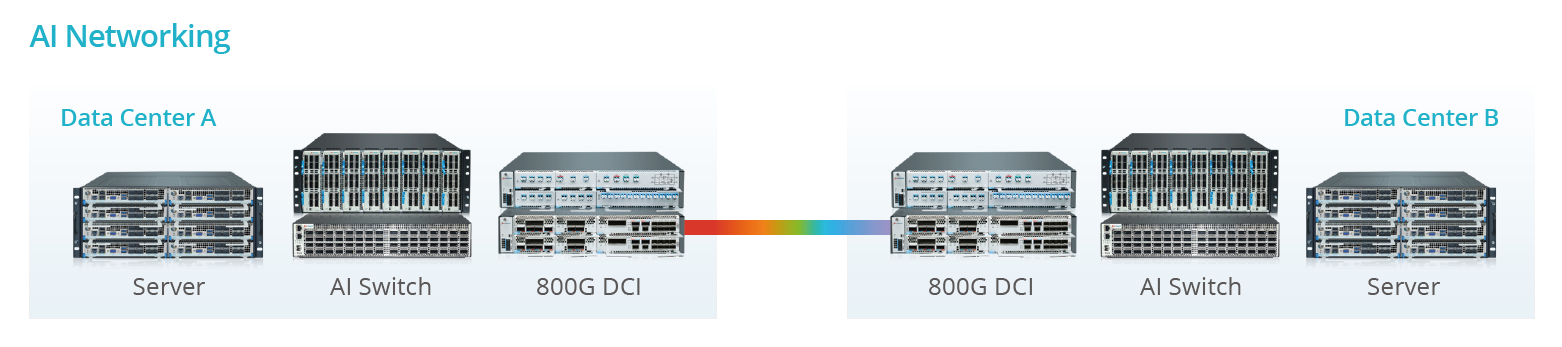
AI workloads are fundamentally changing the traffic profile of data centers. Unlike traditional IT, AI inference is continuous and "always-on," creating sustained, massive bandwidth demand between data centers. Industry forecasts predict that global optical bandwidth will grow fourfold between 2025 and 2027, and network upgrade cycles have compressed from 3-4 years to just 2 years.
To meet this demand, 800G coherent pluggable modules are becoming the standard for AI network connectivity. However, this shift is not merely about speed; it demands a complete architectural rethink. The future DCI network must deliver massive bandwidth, ultra-low latency, and intelligent operations - all while optimizing Total Cost of Ownership (TCO).
Meeting this bandwidth challenge is only part of the equation. The next frontier lies in making the fibre infrastructure itself smarter and more resilient — which is where converged sensing comes in.
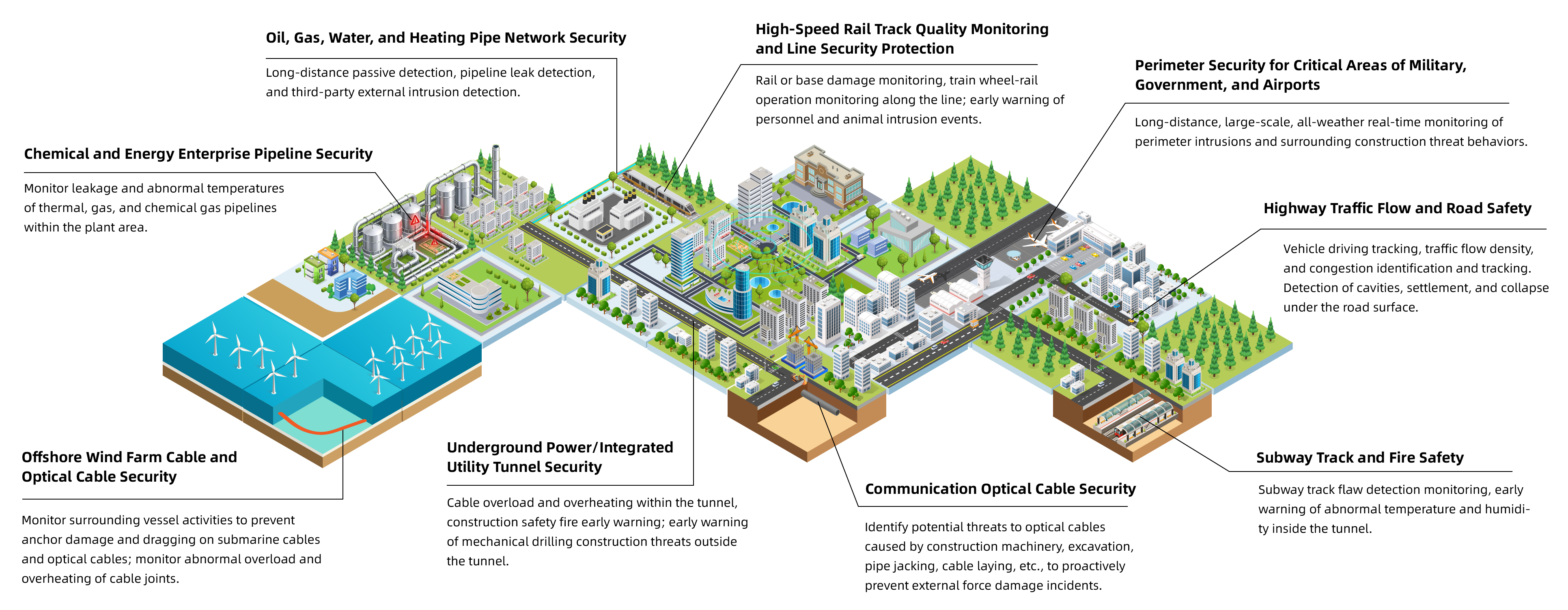
Turn existing communication fibers into "talking nerves." With Sino Telecom’s integrated DAS/DTS solution, the same fiber that carries your 800G traffic also monitors its own health and surroundings - at zero incremental cost.
The Sino‑Telecom platform combines DAS/DTS with OTDR, OLP, and OXC boards to create a closed‑loop system covering:
You already have millions of kilometers of fiber. With our integrated DAS/DTS, you transform that passive asset into an intelligent sensing infrastructure for smart cities and network protection - without deploying additional sensors
Traditional WDM systems are proprietary "black boxes." Once you choose a vendor, you are locked in - costs stay high, innovation stalls, and network evolution slows.
Open, disaggregated modular WDM. Instead of buying an integrated system from one vendor, operators mix and match best‑of‑breed components for the optical layer, electrical layer, and management/control plane - all connected via standard open interfaces.
The STN6800‑D16 platform is built on an open software architecture that supports SNMP and NETCONF interfaces. It can be seamlessly integrated into third‑party NMS systems and managed by a unified SDN controller alongside equipment from other vendors.
With SDN integration, operators can move from static, closed systems to dynamic, programmable networks:
The AI era demands more than just bandwidth. It demands intelligence (your fiber should protect itself), openness (choose the best technology, not the only technology), and convergence (one platform for transmission, sensing, and automation).
Sino‑Telecom’s STN6800-D16 platform delivers exactly that - combining 800G DCI, DAS/DTS sensing, and open disaggregated architecture. It is a practical, proven path to building next‑generation optical networks that are smarter, more cost‑effective, and future‑ready.

 EN
EN