
 EN
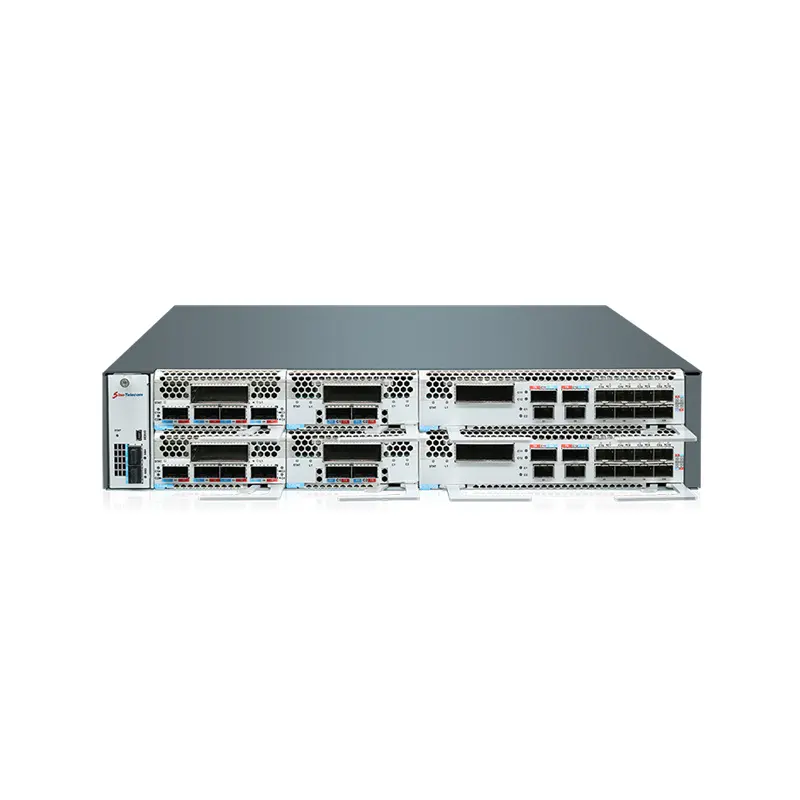
The explosive growth of AI workloads, cloud services and 5G is putting traditional networks at a breaking point. Data centers are proliferating. Traffic patterns are becoming increasingly unpredictable. The proximity of interconnected facilities is shifting – closer in some aspects, farther in others. Network operators are no longer just asking how to increase DCI capacity – they're asking how to do it in the most cost-effective and scalable way possible. Enter DCI-BOX.
The Challenge With Traditional DCI Architectures
The challenges with traditional DCI architectures are enormous. Legacy WDM/OTN systems were designed decades ago for a vastly different market.
These systems often involve large, chassis-based devices occupying 12 rack units or more, deployed across complex mesh topologies for long-haul applications. For metro DCI links and edge router connectivity – where distances are only a few hundred kilometers – such systems are overkill. They consume over 100W per 100G, require segregated 48V DC power, and typically lack the front-to-back airflow that modern data centers demand.
These legacy systems often suffer from their integrated and vendor-locked architectures, hindering ease-of-use and discouraging attempts to apply best-of-breed components and granular scalability.
Understanding the DCI-BOX Architecture
DCI-BOX, also known as modular or compact WDM, addresses the challenge directly by taking a different design approach. Unlike chassis-based systems, a DCI-BOX unit leverages state of the art coherent optical technologies in devices with either a 1U or 2U standard form factor, and having capabilities from 400Gb to 800Gb interfaces directly integrated onto a system provides you high capacity point-to-point optical transport in a drastically more manageable package. The DCI-BOX architecture is unique in providing a truly modular architecture and truly decoupling the optical and electrical layers enabling vendor choice for component hardware and leveraging open standards (e.g., SNMP, NETCONF) toward unifying management as opposed to proprietary Element Management Systems. The choice to employ the “gray box” design methodology is largely responsible for the incredible customer demand and traction that this family of products is getting with operators attempting to avoid deep vendor lock-in strategies.
How DCI-BOX Improves Deployment Flexibility and Scalability
DCI-BOX offers inherent flexibility in its placement and power consumption. Each DCI-BOX fits directly onto the rack, alongside the switches and routers it connects, utilizing standard 220VAC and high voltage DC, or 48VDC as is available. Separate transmission room and complex powering strategies are completely avoided, and scalability in many cases is as simple as stacking on a second device or swapping to a higher capacity muxponder card in order to handle traffic increases. Operators achieve a pay-as-you-grow model at a significantly reduced upfront cost of capital expenditures while simultaneously assuring traffic and network scaling efforts move in lockstep.
Comparing DCI-BOX With Traditional WDM/OTN Systems
Per-100G power consumption is reduced by over 66% (from >100W down to <30W) inmetro and edge data centers. Maintenance is simplified as each DCI-BOX power, fan, amplifier and optic module is field replaceable. Latency is minimized while meeting demanding SLAs. Sub-3-microsecond one-way latency has been documented for critical applications like financial trading and AI training – 15 microseconds for OTN-based networks, due to complex cross-connect and mapping functions.
However, it is important to understand that WDM/OTN traditional equipment does fully support a comprehensive optical mesh with ROADM based wavelength provisioning as a native function of the device, while DCI-BOX is purely optimized and designed for point-to-point high-capacity transport.
The network role you need to fill is critical in determining which architecture is appropriate.
Deployment Scenarios Across Metro, Edge, and Regional Networks
Operator decisions to deploy DCI-BOX in three tiers:
Metro DCI: Metro data center owners and operators use the platform in Spine-Leaf data center topologies with inter connections of PODs or Points Of Prescence within large metropolitan cities, in large and small scale metro deployments utilizing the technology to reduce east-west latency to improve Spine-Leaf throughput, increase Spine-Leaf performance, reduce the CapEx as well as OpEx, and guarantee that all interconnect functions remain at layer 1.
Edge Data Center Connectivity: The most cost effective and fastest method to provide 100G optical layer interfaces for 5G backhaul, broad-band access aggregate and enterprise services to county or township level locations with small to medium distance optics. 100G coherent optics modules are used at a fixed price per wavelength, making it ideal for these metro and edge scenarios traveling less than 150 kilometers
Regional Data Center Connectivity: For distances of up to 600 kilometers, where traditional WDM might otherwise be required, DCI-BOX units supporting higher powered coherent modules coupled with a fixed 800G coherent pluggable module, can replace larger, expensive equipment with more manageable, scalable and less costly devices, providing optimal capacity and simplicity over longer transport distances compared to a fully scale capable WDM system deployment.
Why Operators and Data Centers Choose DCI-BOX
Operators select DCI-BOX due to its superior value for money, its open approach, and its simplified management features. Industry benchmarks show a cost-per-100G-wavelength value of approximately $8 for DCI-BOX in metro link scenarios, compared to roughly $20 for traditional WDM – representing more than twice the value per 100G. In terms of network openness, operators avoid Vendor locked equipment when utilizing a grey box WDM solution so that they can apply the best available optical layer equipment and electrical layer equipment of their choosing-regardless of the vendor that provided their routing or switching. DCI-BOX platforms enable operators to embrace existing orchestration systems with its native ability to manage these devices with open standards and protocols such as SNMP, and NETCONF.
Conclusion
The DCI-BOX isn't a lighter version of a WDM system; it is a new kind of device designed specifically for the data-centric, AI-driven world we are rapidly entering. The constraints it removes concerning space, power and cost overcome challenges that traditional architectures simply cannot address while still ensuring an extremely high level of openness and scalability operators require today.
Sino-Telecom Technology Co., Inc. has been one of the leaders in this changing landscape. With over a decade of expertise in optical networks and data communications, Sino-Telecom is a world leading supplier of DCI, with cumulatively over 100,000 units deployed. Our focus on technological advancement – backed by 241 patents and 156 software copyrights has led to a comprehensive line of DCI-BOX solutions. Sino-Telecom has a full range of DCI-BOX OTN based solutions in their portfolio such as the STN6800-D16 platform series, with as much as 6.4T in a 1U device and 12.8T in a 2U chassis – ensuring a powerful, compact, and future-proof optical transport network. Contact us today for a free consultation or a competitive quote, and let’s help build the high capacity open networks of tomorrow.
Table of Contents
- The Challenge With Traditional DCI Architectures
- Understanding the DCI-BOX Architecture
- How DCI-BOX Improves Deployment Flexibility and Scalability
- Comparing DCI-BOX With Traditional WDM/OTN Systems
- Deployment Scenarios Across Metro, Edge, and Regional Networks
- Why Operators and Data Centers Choose DCI-BOX
- Conclusion