Home > Products > IP Networks > Campus Switch
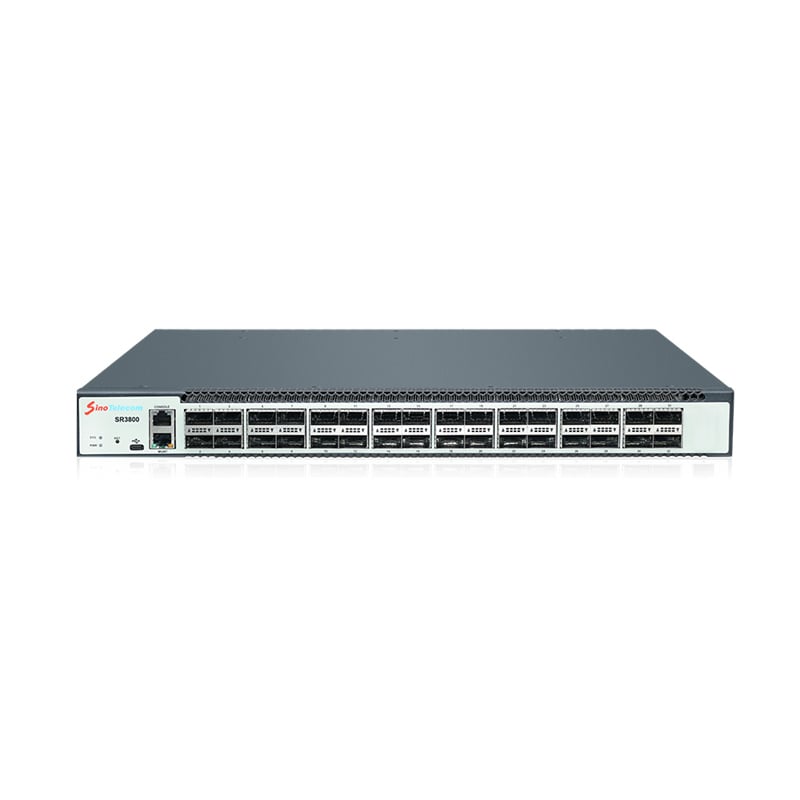
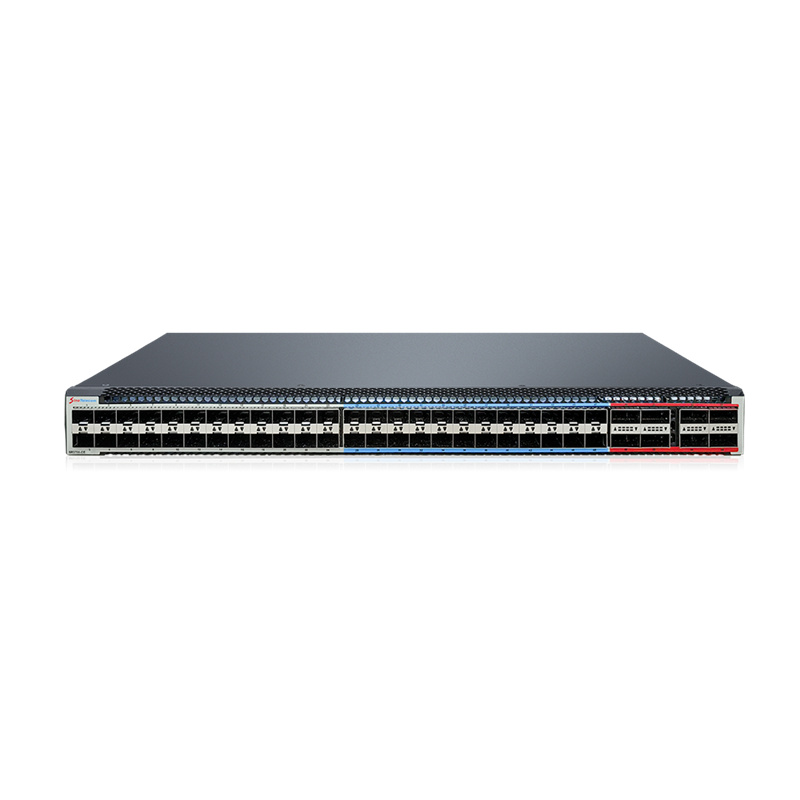
SR3100-48G4XS is a next-generation green and energy-efficient Gigabit Ethernet switch launched by Sino for enterprise campus networks.
The SR3100-48G4XS is Sino's next-generation energy-efficient Gigabit Ethernet switch for enterprise campus networks. Built on cutting-edge hardware and Sino's proprietary SROS software platform, it delivers streamlined deployment, robust Layer 2/3 functionality, and seamless IPv6 migration. Featuring intelligent stacking, cluster management, and rapid loop protection, this switch significantly enhances network stability, empowering organizations to build future-ready IT infrastructure for office and production environments.
The product features an advanced hardware architecture design with industry-leading processing power. The 1U rack-mounted switch delivers the industry's highest port density of 48 Gbps + 410Gbps ports, powered by high-performance ASIC switching chips to meet diverse complex application requirements.
Key system components, such as power supply and fan modules, are configured redundantly to support seamless failure switching without manual intervention.
Supports STP/RSTP/MSTP protocols, VRRP, and features redundant protection mechanisms including ring protection, dual uplink primary/backup link protection, and LACP link aggregation.
The ultra-high precision BFD bidirectional link detection mechanism, through the interaction with the second and third layer protocols, realizes millisecond fault detection and service recovery, greatly improving the reliability of the network system.
The high reliability design of hardware and software meets the millisecond-level failure recovery time requirements of telecom-grade services, and truly achieves the high reliability of 59s (99.999%) for operational-grade core equipment.
The fully developed two-and three-tier multicast routing protocol supports IPTV, multi-terminal HD video surveillance, and HD video conferencing access.
The comprehensive three-tier routing protocol and large routing table capacity meet the needs of various types of network interconnection, and can be used to build large campus networks, enterprise networks and industry user private networks.
Supports L2-L4 packet filtering and provides flow classification technology. Offers flexible queue scheduling algorithms that can be configured for both ports and queues, supporting PQ, WFQ, WRR, WRED, and other queue scheduling mechanisms, as well as congestion avoidance mechanisms like WRED and tail drop.
Full support for the IPv6 protocol suite, including IPv6 neighbor discovery, ICMPv6, Path MTU discovery, DHCPv6, and other IPv6 features.
Supports IPv6-based Ping, Traceroute, Telnet, SSH, ACL, and other protocols to meet the needs of pure IPv6 network device management and service control.
It supports IPv6 multicast features such as MLD and MLD Snooping, and IPv6 Layer 3 routing protocols including static routing, RIPng, OSPFv3, and BGP4+. The solution provides users with comprehensive IPv6 Layer 2 and Layer 3 connectivity.
Device-level security: The advanced hardware architecture enables hierarchical packet scheduling and protection, defending against DoS attacks, TCP SYN Flood, UDP Flood, broadcast storms, and high traffic. It also provides command-line access control with tiered permissions.
Comprehensive security authentication mechanism: Supports IEEE 802.1x, MAC authentication, Radius, Tacacs+, and other authentication methods, providing users with a complete security authentication mechanism.
Enhanced security mechanisms: Supports plaintext or MD5 authentication for relevant routing protocols, and uRPF reverse routing lookup technology to effectively control unauthorized traffic. Hardware-level packet deep inspection and filtering technology enables deep detection of control and data packets, effectively isolating malicious data packets and enhancing network system security.
Supports multiple management interfaces including Console, SNMPv1/v2/v3, and a universal network management platform. It provides CLI command-line, Web management, TELNET, and SSH access for streamlined device management, with enhanced security through SSH2.0 and SSL encryption.
Supports SPAN/RSPAN mirroring and multiple mirroring observation ports. It analyzes network traffic output to take appropriate management and maintenance actions, and provides users with various network traffic analysis reports to help them optimize network structure and adjust resource deployment in a timely manner.
The advanced power system architecture design enables efficient power conversion, unique power monitoring, slow start-up and other functions, real-time monitoring of the running state of the whole machine, intelligent adjustment, deep energy saving.
Supports AC/DC/HVDC power types for flexible power distribution.
Supports energy-efficient Ethernet features compliant with the international IEEE 802.3az standard, effectively reducing energy consumption.
|
product model |
SR3100-48G4XS |
|
product size |
440×280×44mm (1U height) |
|
exchange capacity |
196Gbps |
|
Packet forwarding rate |
142Mpps |
|
Port configuration |
48 GE optical ports + 410GE/GE optical ports |
|
Management port |
1 Console port |
|
MAC entry |
32K |
|
FIBv4 entry |
12K |
|
FIBv6 entry |
4K |
|
ARP entry |
2K |
|
ND entry |
2K |
|
ACL entry |
1K |
|
VLAN quantity |
4K |
|
L2 protocol |
IEEE802.1Q、IEEE 802.3ad、IEEE802.1ad(QinQ)、STP/RSTP/MSTP、LLDP、Jumbo Frame |
|
L3 protocol |
Static routing, policy-based routing, OSPF, RIP, IS-IS, BGP4, ECMP, ARP, VRRP, DHCP |
|
IPv6 protocol |
ND、Path MTU、ICMPv6、DHCPv6、IPv6 Telnet、IPv6 ACL、IPv6 QOS |
|
IPv6 features |
Static routing, policy-based routing, OSPFv3, RIPng, BGP4+, MLD snooping |
|
QoS |
Supports EXP priority mapping for 802.1p, DSCP, ToS, and other EXPs Supports ACL flow classification and priority marking (Mark/Remark) Supports PQ, WFQ, WRR, and multiple queuing scheduling mechanisms Supports congestion avoidance mechanisms such as WRED and tail drop |
|
Security features |
Supports DDoS attacks, ICMP attacks, ARP attacks, and more Supports AAA authentication such as RADIUS/TACACS+ Supports IPv4/v6 ACL packet filtering based on standards, extensions, and VLANs Supports MD5 authentication for OSPF, RIPv2, and BGPv4 messages Supports port isolation, port security, 802.1x authentication, and MAC authentication Supports Telnet login and password mechanism with restricted IP addresses, and supports user-level management Supports uRPF detection and suppression of broadcast, unknown unicast, and multicast packets |
|
Manage and maintain |
Web management, SNMP v1/v2/v3, Telnet, Console, RMON, SSH v1/v2, FTP/TFTP file download management, NTP, Syslog, SPAN/RSPAN, fan support, power alarm, and other anomaly alerts |
|
working voltage |
AC:90V-264V DC:-36V~-72V HVDC:180V-300V |
|
working temperature |
0 to 50°C, with hourly changes of less than 10°C |
|
Working humidity |
10% to 90% (no condensation, no frost) |
|
above sea level |
-500~2000m |
|
Dust resistance |
≤30,000 particles/liter (when dust particles are ≥0.5μm) |
|
Seismic intensity |
≤8 degrees |
|
MTBF |
> 100,000 hours |
|
Power consumption |
72W |
|
Total weight |
7kg |
|
Power fan |
Built-in 1+1 power supply, built-in 2+1 fan |
|
Green and energy-saving |
Supports IEEE 802.3az Green Energy Efficiency Ethernet |
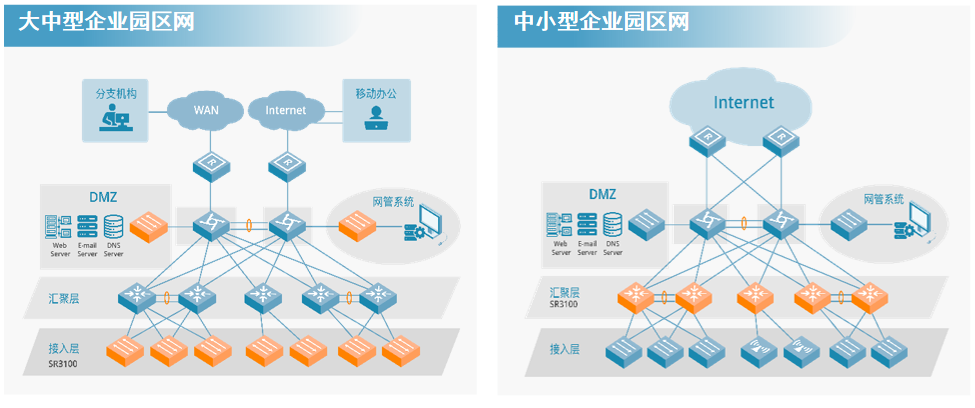
Scenario for large and medium-sized enterprise campus networks
The SR3100 series is deployed in the access layer of campus networks in large and medium-sized enterprises, enabling access for office terminals, wireless APs, and other devices to build high-performance, highly reliable enterprise campus networks.
Small and medium enterprise campus network scenario
The SR3100 series is deployed in the aggregation layer of SME campus networks, providing GE/10GE aggregation capabilities to help users build high-performance, multi-service converged, and highly reliable enterprise campus networks.

 EN
EN