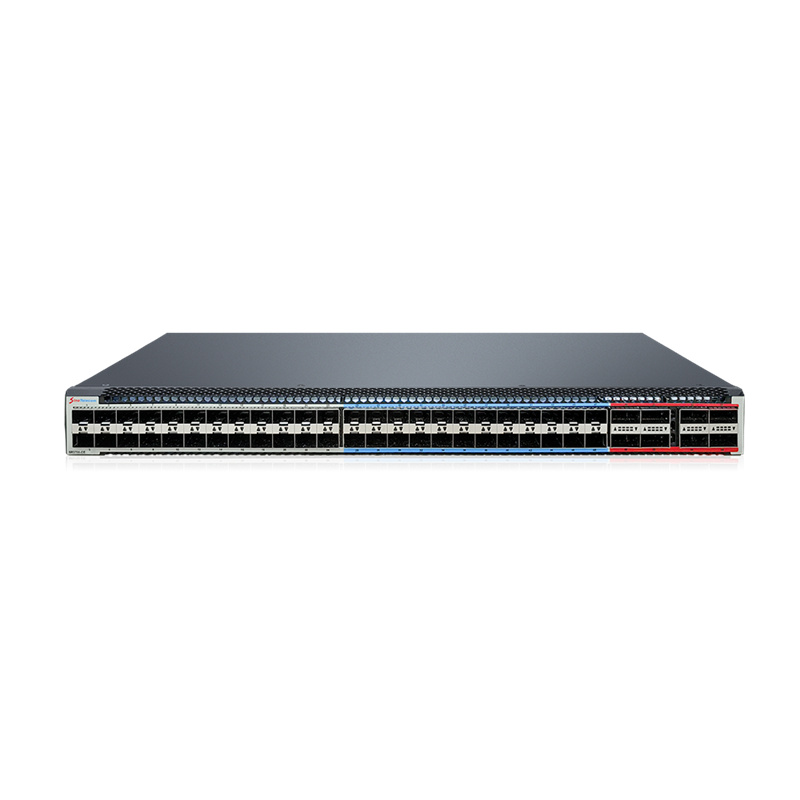
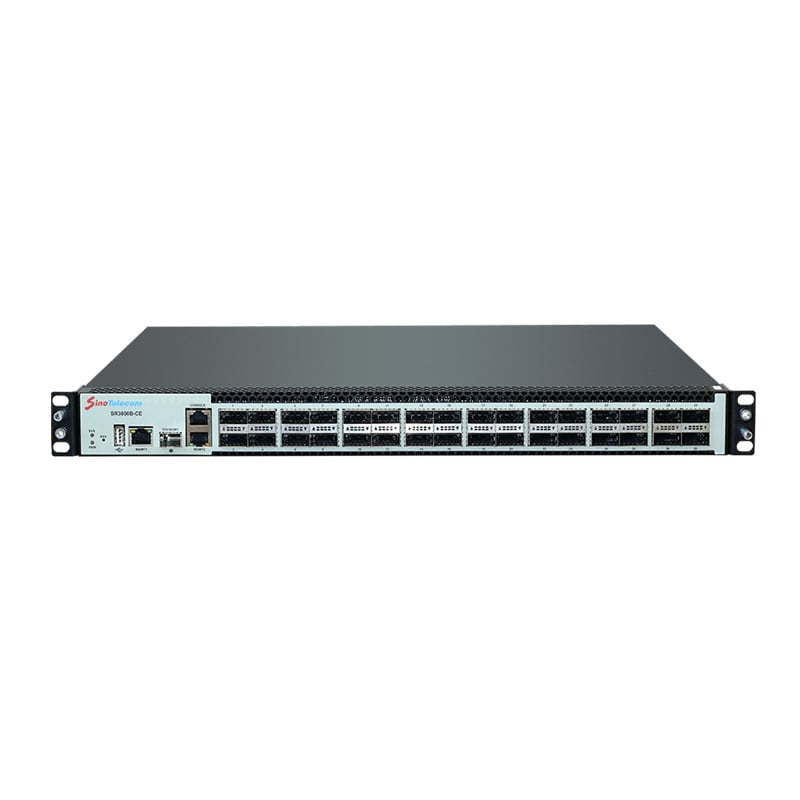
SR3700-CE is a domestically developed white-box switch by Sino, designed for users in industries such as the internet, telecom operators, and research laboratories.
The SR3700-CE is a 100GE domesticay deveoped white-box switch by Sino, designed for internet, teecom operators, and research aboratories. With a tota switching capacity of 4Tbps (bidirectiona), it features 48 ports for 25GE/10GE and 8 ports for 100GE/40GE. The switch utiizes domesticay produced proprietary chip soutions, supports BMC, ONIE, and SONiC systems, and offers fexibe configurations with CPU expansion cards, DDR4 memory, and SSD storage. This versatie hardware meets diverse product requirements and enabes users to impement more open and fexibe networking soutions. Technica specifications
Featuring an advanced hardware architecture design with industry-eading processing power, this 1U rack-mounted switch deivers an impressive port density of 4825GE/10GE ports and 8100GE/40GE ports. Powered by high-performance domestic switching chips, it meets the demands of diverse compex scenarios.
To meet the requirement of non-bocking data transmission for high-traffic data in data centers, it provides powerfu cache capacity and supports advanced cache scheduing mechanism to ensure the effective utiization of device cache capacity.
With an open device architecture and the idea of decouping software and hardware, the underying hardware and upper-ayer software can be customized on demand according to business requirements.
On the data pane, integrate hardware acceeration cards such as smart NICs and FPGAs to offoad network traffic through hardware acceeration, thereby reducing overa network atency and minimizing resource consumption of CPU and switching chips.
The software is depoyed in containers, which simpifies unified management and reduces network operation and maintenance costs.
Customize the underying hardware and upper-ayer software on demand to reduce the purchase cyce and cost of switches; in terms of software functions, secondary deveopment can be carried out based on open source software to reduce the deveopment cyce and cost.
Board port management support: incuding MAC address acquisition, TX PHY channe acquisition, RX PHY channe acquisition, TX poarity acquisition, RX poarity acquisition, port information acquisition, port configuration acquisition, and board type acquisition.
Periphera management support: incuding MAC address acquisition for network cards and pane ports, EEPROM dispay, device temperature monitoring, chip temperature measurement, power status inquiry, fan speed detection and adjustment, etc.
Supports QSFP management: incuding QSFP port detection, SFP main information dispay, QSFP brief information dispay, QSFP power mode acquisition, QSFP power mode setting, QSFP on-board information acquisition, QSFP medium type acquisition, QSFP connection status, QSFP reset bit setting, QSFP remova
Key system components, such as the power modue with 1+1 backup and the fan modue with 4+1 backup, a support hot-pugging and seamess faiover without manua intervention.
Support power and fan faut detection and aarm, can automaticay adjust the fan speed according to the change of temperature, and adopt overcurrent protection, overvotage protection and overheating protection.
Adopt advanced power system architecture design, reaize efficient power conversion, unique power monitoring, sow start and other functions, rea-time monitoring of the whoe machine running status, inteigent adjustment, deep energy saving.
Inteigent fan management system: Inteigent fan design, support automatic speed adjustment, effectivey reduce speed, reduce noise, and extend the service ife of the fan.
Supports Energy-Efficient Ethernet (EEE) compiance with the IEEE 802.3az standard, effectivey reducing energy consumption.
|
product model |
SR3700-CE |
|
|
product size |
442mm×386mm×44mm (1U height) |
|
|
Exchange chip |
Domestic switching chip (Shengke CTC8186) |
|
|
exchange capacity |
Switch capacity: 2.0 Tbps, total switch capacity: 4.0Tbps |
|
|
Packet forwarding rate |
2000Mpps |
|
|
Full machine cache |
32M |
|
|
Port configuration |
48×25GE SFP28 ports (backward compatible with 10GE SFP+) + 8×100GE QSFP28 ports (backward compatible with 40GE QSFP+), supporting 1/4 optical fiber |
|
|
CPU |
Domestically produced chip (Phytium E2000Q), ARM architecture, 4-core, 2.0GHz clock speed |
|
|
CPU and switch chip internals ETH channel |
2*10GBase-KR internal ETH channel, supports DPDK |
|
|
internal storage |
DDR4 SO-DIMM memory with 16GB capacity and 2133MHz frequency, supporting ECC |
|
|
SSD memory |
Enterprise SSD with 128GB storage capacity (optional, not configured by default) |
|
|
BMC |
Support BMC online upgrade Supports board-wide and CPU reset management Support FRU changes and save EEPROM Support device restart, access to the CPU console, and other functions Support fan speed, obtain the whole machine's energy consumption, and obtain the temperature of the switching chip Supports configuration of static IPv4 addresses, static IPv6 addresses, and DHCP automatic acquisition Supports monitoring the main board voltage (DC-DC), temperature, fan, and power status, and supports SSH login |
|
|
CPLD |
Supports online CPLD upgrade. The CPLD firmware version is available for check. |
|
|
Management Port |
2 GE MGMT RJ45 management ports |
|
|
gorge line |
1 CONSOLE RJ45 management port (support COMe/BMC switching) |
|
|
USB mouth |
1 USB2.0 port |
|
|
operating system |
l Supports ONIE (MASTER) Supports SoniC 202305 (Linux kernel 5.10.153) |
|
|
|
Supports SoniC 202205 (Linux kernel 5.10.209) l SAI(1.12.0-3) |
|
|
Exchange chip specifications |
MAC |
160K |
|
IP Host |
32K |
|
|
LPM(v4) |
384K |
|
|
Flow Hash |
0 |
|
|
SCL0/1 |
24K/16K |
|
|
EgressSCL0/1 |
8K/0 |
|
|
OAM |
4K |
|
|
LM |
1K |
|
|
L2MC |
8K |
|
|
L2MC |
8K |
|
|
NextHop |
96K |
|
|
|
PORT |
Supports port admin status settings |
|
Supports port link status notifications |
||
|
Supports port splitting. A 100G port can be split into 4×25G ports. |
||
|
Supports port speed reduction. 100G ports support 100G and 40G speeds, while 25G ports support 25G,10G, and 1G speeds. |
||
|
Supports port negotiation settings |
||
|
Supports FEC port, pre-weighting parameters, and media type settings |
||
|
Supports port speed limits and configuration based on pps and bps |
||
|
Supports port storm control, requires support for broadcast, multicast, and flood packet types, and supports configuration based on PPS and BPS |
||
|
Support MTU settings |
||
|
LAG |
Supports adding and deleting LAG members |
|
|
Support LAG Member Ingress/Egress disable |
||
|
Supports LAG Hash seed and configurable algorithm |
||
|
SAI characteristic |
|
Supports LAG Hash Key configuration |
|
Isolation |
Supports port isolation based on Port and LAG configurations |
|
|
VLAN |
Supports 4K VLAN |
|
|
Supports Port VLAN, Default VLAN Priority |
||
|
Supports setting VLAN inspection for ports and LAGs |
||
|
Supports adding and removing VLAN members based on ports and LAGs |
||
|
L2 Forward |
Supports MAC learning mode settings, including disable, hardware learning, and trap modes. Configuration can be based on ports or LAGs. |
|
|
Supports MAC addition and deletion |
||
|
Supports MAC aging, with configurable aging time |
||
|
Support MAC Notify |
||
|
Supports MAC Flush, based on PORT, LAG, VLAN, and Switch |
||
|
support stp |
||
|
Three-tier functionality |
Supports VLAN, PORT, LAG, and LOOPBACK interfaces, with a minimum of 4K interfaces |
|
|
Supports IPv4 and IPv6 |
||
|
Supports three-layer interface MAC configuration |
||
|
Supports three-layer interface IPv4 and IPv6 forwarding control |
||
|
Supports three-layer interface MTU configuration |
||
|
Supports black hole routing |
||
|
Supports routing table settings and user meta data |
||
|
support VRF |
||
|
Supports ECMP. The maximum number of ECMP members can be configured. |
||
|
ECMP supports configurable hash seed, algorithm, and key |
||
|
|
|
ECMP supports Resilient Hash and DLB |
|
Automatically update routing when the next hop changes |
||
|
Tunnel |
Supports IP in IP Tunnel |
|
|
Supports GRE Tunnel |
||
|
Supports Vxlan Tunnel, including L2 Vxlan and L3 Vxlan |
||
|
Supports automatic tunnel update when the next hop changes |
||
|
ACL |
Support Ingress ACL and Egress ACL |
|
|
Supports ACL binding for PORT, LAG, and VLAN |
||
|
Supports MAC ACLs, enabling matching for smac, d mac, ethernet type, VLAN, and VLAN range |
||
|
Supports IP ACL, which can match SIP, DIP, protocol, L4 destination port, L4 source port, DSCP, and TCP flags |
||
|
Supports IPv6 ACL, which can match SIP6, DIP6, next-header, L4 destination port, L4 source port, and TCP flags |
||
|
Supports MAC IP ACL, which can match smac, dmac, sip, dip, protocol, l4 dst port, l4 src port, dscp, and tcp flag |
||
|
Enable permit, drop, trap, redirect, and policer actions |
||
|
Supports configuring ACL tables with 12 or more |
||
|
QoS |
Supports configuring trust COS and trust DSCP based on ports |
|
|
Supports configuration based on cos and dscp mapping priorities |
||
|
Supports unicast and multicast queues |
||
|
Set queue weight, minimum bandwidth, and maximum bandwidth |
||
|
Support SP/WRR/WDRR scheduling |
||
|
Supports PFC and PFCWD |
||
|
Supports WRED and ECN, and allows setting thresholds for green, yellow, and red packets. |
||
|
|
Buffer |
Supports Buffer Pool and Profile parameter configuration |
|
Supports PG and Queue buffer profile binding |
||
|
Supports Buffer statistics, current occupancy, and watermark |
||
|
CoPP |
Supports total speed limit for CPU packets |
|
|
Supports speed limit protocol. Rate and priority are configurable. |
||
|
Supports port statistics for sending and receiving, including RFC1213, RFC1757, RFC2465, and RFC2665 |
||
|
Traffic Monitoring |
Supports queue statistics, including message count, byte count, and discarded count |
|
|
Supports port mirroring |
||
|
Supports ERSPAN |
||
|
support sFlow |
||
|
Supports MOD and collects discarded messages |
||
|
Supports In-band Network Telemetry, with specified packets containing metadata such as Device ID, Ingress Port, Egress Port, T, RX Timestamp, and TX Timestamp. |
||
|
working voltage |
AC: 100V-240V , ± 10% DC: -36V~-72V HVDC: 180V-300V |
|
|
working temperature |
0 to 50°C, with hourly variations of less than 10°C |
|
|
Working humidity |
5% to 95% (no condensation, no frost) |
|
|
above sea level |
-500~2000m |
|
|
Dust resistance |
≤ 30,000 particles/liter (when dust particles are ≥0.5 μm) |
|
|
Seismic intensity |
≤8 degrees |
|
|
MTBF |
> 100,000 hours |
|
|
Power consumption |
Typical: 162W; Maximum: 200W |
|
|
Total weight |
8kg (including 2 power modules and 5 fan modules) |
|
Data center scenario
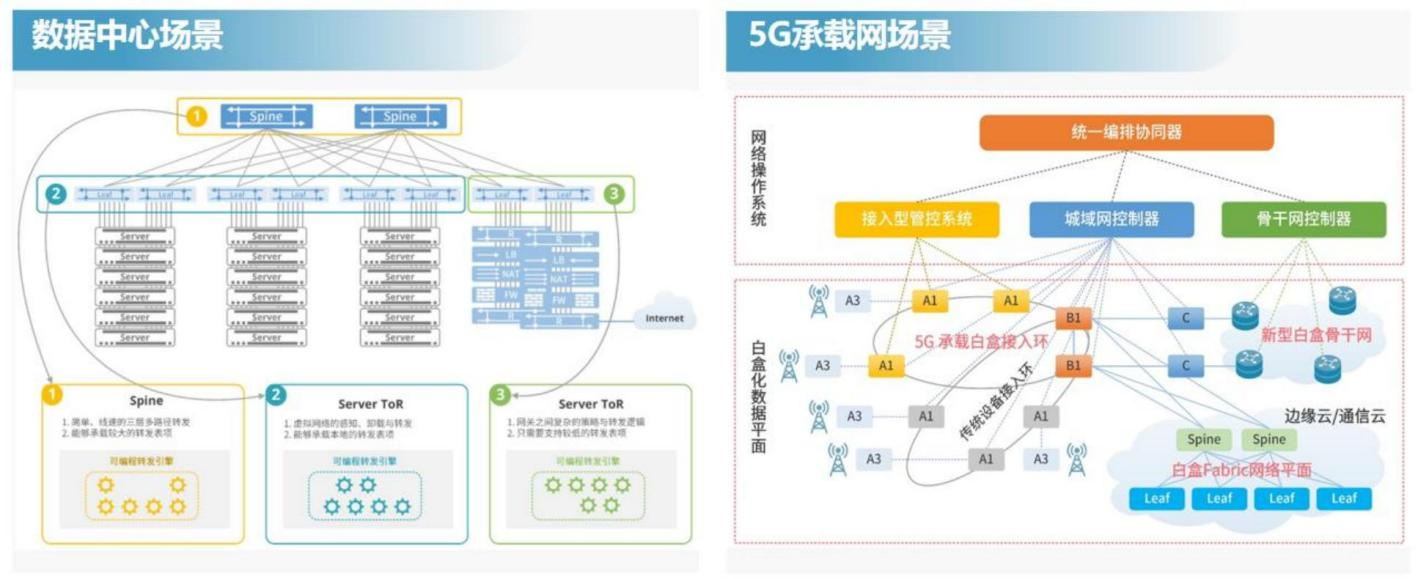
Data center environments with well-defined requirements and clear network architectures are ideal for white-box switches. By deploying these switches, enterprises gain full control over their software and hardware operations, enabling the construction of cost-effective, highly reliable, high-performance, automated, and intelligent data center networks. In specific scenarios, the SR3700-CE acts as a Leaf node, providing 25GE port access and 100GE uplink capabilities to establish end-to-end 100GE connectivity. Furthermore, through integration with technologies like stacking, link aggregation, VxLAN, and EVPN, it creates a seamless Layer 2 VxLAN overlay network. This infrastructure ensures large-scale virtual machine migration and flexible deployment of user services.
5G bearer network scenario
5G bearer networks emphasize programmable, deterministic, customizable, and high-performance requirements for network protocols and functionalities, delivering dedicated line services with software/hardware slicing and QoS guarantees. White-box switches are transforming the traditional switch and router paradigm, achieving full compatibility across all scenarios from access bearer networks to next-generation backbone systems. In edge cloud/communication cloud networking, the SR3700-CE serves as a Leaf node, offering 25GE port access capability and 100GE uplink capacity to establish end-to-end 100GE connectivity solutions.

 EN
EN