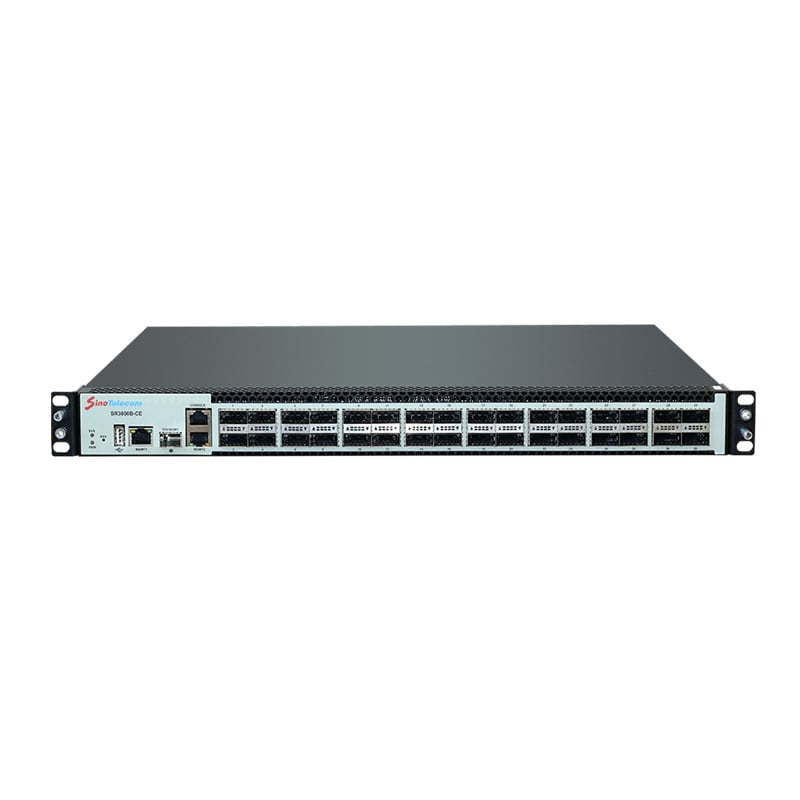
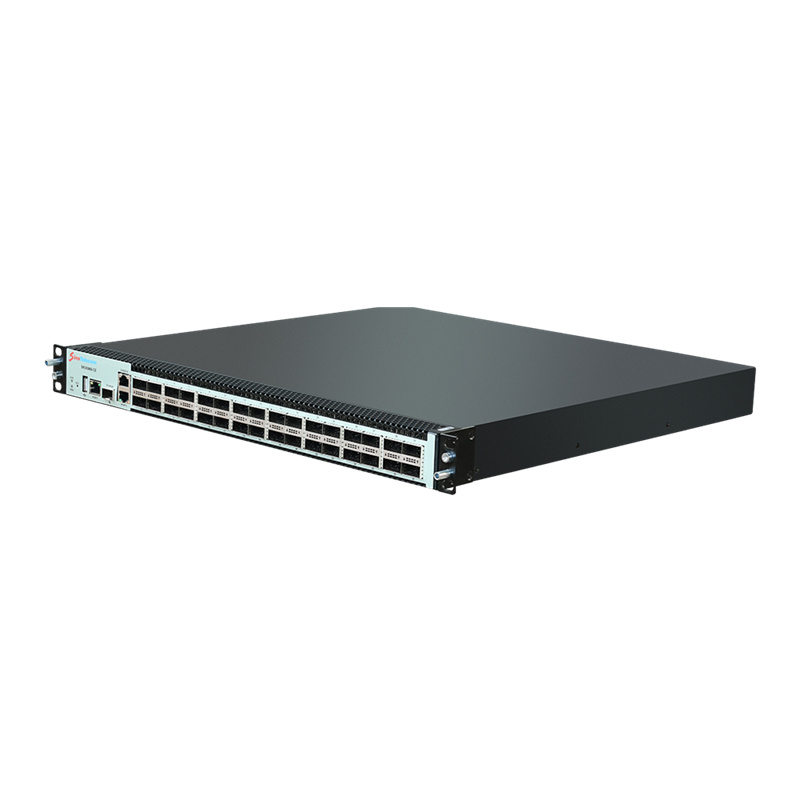
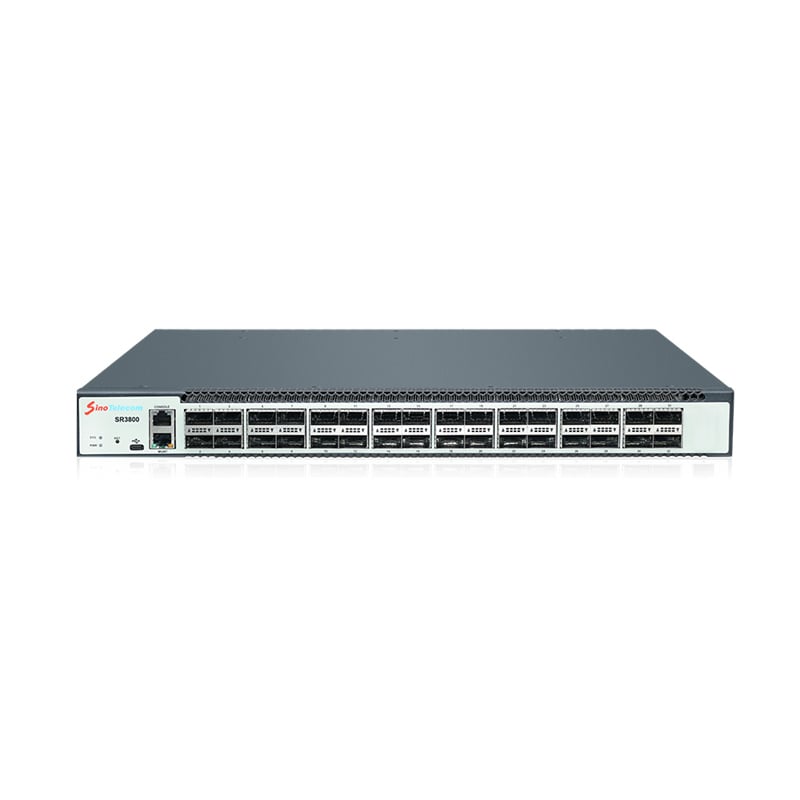
SR3800B-CE is a 100GE programmable white-box switch developed by Sino for users in industries such as the internet, telecom operators, and research laboratories.
The SR3800B-CE is a 100GE programmable white-box switch developed by Sino for industries including internet, telecom operators, and research laboratories. With a total switching capacity of 6.4 Tbps, it features 32100GE/40GE ports. Powered by Intel Tofino Series P4 programmable chips, the switch supports BMC, ONI, and SONIC systems, and offers flexible options for CPU card insertion, DDR4 memory, and SSD storage expansion. This versatile solution meets diverse hardware requirements and enables users to implement more open and flexible network architectures.
Powered by cutting-edge hardware architecture and industry-leading processing capabilities, this 1U rack-mounted switch delivers 32 high-density 100GE/40GE ports. Featuring Intel Tofino P4 programmable switching chips, it meets diverse application requirements in complex scenarios.
To meet the requirements of non-blocking data transmission for high-traffic data in data centers and 5G bearer networks, the system provides powerful cache capabilities and supports advanced cache scheduling mechanisms to ensure effective utilization of device cache capacity.
By adopting an open device architecture and the idea of decoupling software and hardware, the underlying hardware and upper-layer software can be customized on demand according to business requirements.
Supports network programmability, which allows the chip's packet processing and forwarding logic to be adjusted as needed through software.
Supports the integration of hardware acceleration cards such as smart network cards and FPGAs on the data plane. By leveraging hardware acceleration technology, it offloads network traffic to reduce overall network latency and minimize resource consumption of CPU and switching chips.
Customize the underlying hardware and upper-layer software on demand to reduce the purchase cycle and cost of switches. In terms of software functions, secondary development can be carried out based on open source software to reduce the development cycle and cost.
It fully supports P4 programmability, enabling P4 programming for every Pipeline in the data plane, including the parser, deparser, and all match-action stages.
Supports customizing the parsing of various protocol messages.
Supports designing message processing pipelines based on functional requirements.
Support flexible allocation of L2/L3 table resources. (Under development)
Supports programmable packet forwarding actions, including but not limited to: forwarding, discarding, redirecting, and packet replication. (Under development)
Supports custom checksum calculation for message content.
Supports programmable table item matching methods, including but not limited to: exact match, TCAM match. (Under implementation)
Supports management of board port information, including: MAC address retrieval, TX PHY channel retrieval, RX PHY channel retrieval, TX polarity retrieval, RX polarity retrieval, port information retrieval, configuration retrieval, and board type retrieval.
Peripheral management support: includes MAC address acquisition for network cards and panel ports, EEPROM display, device temperature query, Tofino chip temperature, power supply information, fan speed query/set, etc. Peripheral management support: including MAC address acquisition for network cards and panel ports, EEPROM display, device temperature query, Tofino chip temperature, power supply information, fan speed query/set, etc.
Supports QSFP management: including QSFP port detection, SFP main information display, QSFP brief information display, QSFP power mode retrieval, QSFP power mode setting, QSFP on-board status retrieval, QSFP media type retrieval, QSFP connection status, QSFP reset bit setting, QSFP removal
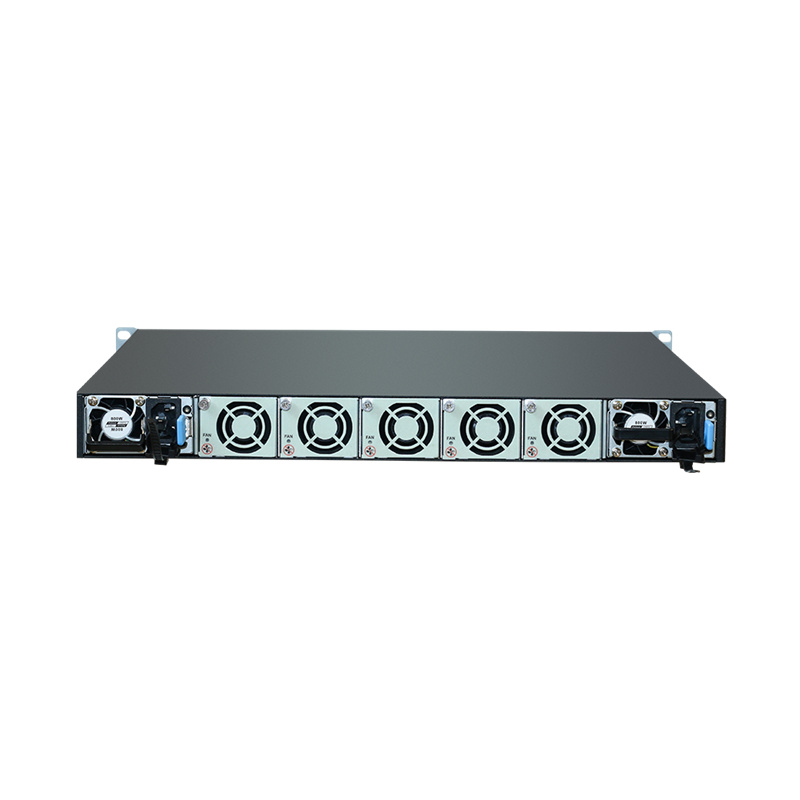
Key system components, such as the power module with 1+1 backup and the fan module with 4+1 backup, support hot-plugging and seamless failover without manual intervention.
Support power and fan fault detection and alarm, automatic adjustment of fan speed according to temperature change, and overcurrent protection, overvoltage protection and overheating protection.
Supports multiple management ports, including Console RJ45 serial port, 10G MGMT management port, and GE MGMT RJ45 management port. It provides CLI command-line and web-based management for easier device administration, and supports encryption methods such as SSH2.0 and SSL for enhanced security.
The advanced power system architecture design enables efficient power conversion, unique power monitoring, slow start-up and other functions, real-time monitoring of the running state of the whole machine, intelligent adjustment, deep energy saving.
Intelligent fan management system: Intelligent fan design, support automatic speed adjustment, effectively reduce the speed, reduce noise, and extend the service life of the fan.
Supports energy-efficient Ethernet features compliant with the IEEE 802.3az international standard, effectively reducing energy consumption.
|
product model |
SR3800B-CE |
|
product size |
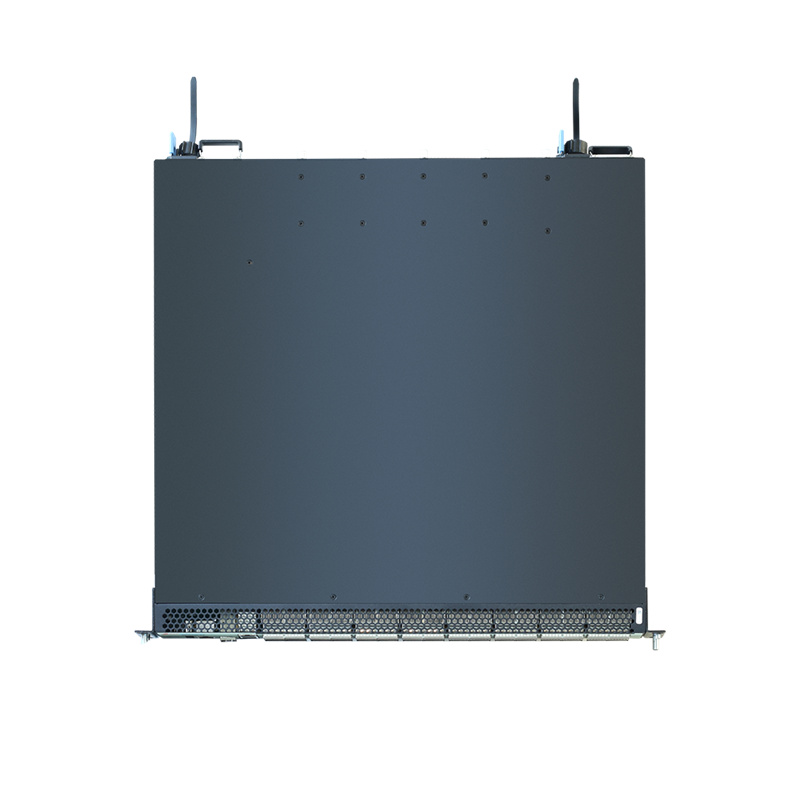
440mm×450mm×44.5mm (1U height) |
|
Exchange chip |
Intel Tofino132D(3.2Tbps (2 pipelines) / 32Q(3.2Tbps (4 pipelines) |
|
exchange capacity |
6.4Tbps (bidirectional) |
|
Packet forwarding rate |
2030Mpps |
|
Port configuration |
32×100GE QSFP28 ports (backward compatible with 40GE QSFP+), supporting 1/4 optical fiber |
|
CPU |
Intel Xeon D-1713NT (4-core, 2.2GHz), standard COMe Type7 socket |
|
internal storage |
DDR4 SO-DIMM memory with 16GB capacity (dual-channel, expandable up to 64GB), supporting hold ECC |
|
SSD memory |
Enterprise SSD with storage capacity ≥128GB |
|
BMC |
Size: 69.6mm in length, 50mm in height, compliant with the RUNBMC card specification. Support horizontal and vertical installation structures CPU: AST2500 (1-core, 800MHz) Memory: 1G onboard memory Flash: 1 board with EMMC storage, capacity no less than 8GB Supports onboard temperature sensors for reading card temperature Supports onboard key voltage sensors for monitoring critical power supplies on the card. Supports NCSI interface Working temperature: 0°C~55°C (standard), -20°C~ 80°C (wide temperature) Working humidity: 5%~90% (no condensation) Supports IPMI2.0 Support BMC online upgrade Supports primary and backup images, as well as primary and backup partitions Supports board-wide and CPU reset management Support FRU changes and save EEPROM Support device restart, access to the CPU console, and other functions Support fan speed, obtain the energy consumption of the whole machine, and obtain the temperature of the switching chip Supports configuring static IPv4 addresses, static IPv6 addresses, and DHCP auto-assignment Supports monitoring and obtaining key board parameters including voltage (DC-DC), temperature, fan status, and power status. Supports SSH login and access to the BMC management web page through a browser |
|
CPLD |
Supports online CPLD upgrade. Check the CPLD firmware version. |
|
Management Port |
110G MGMT management port, 2 GE MGMT RJ45 management ports |
|
gorge line |
1 CONSOLE RJ45 management port (support COMe/BMC switching) |
|
USB mouth |
1 USB2.0 port |
|
operating system |
Supports ONL (Kernel Linux 4.14.151) Supports CentOS 7 (Linux kernel 4.19) |
|
SDE & SDE BSP |
Supports SDE 9.7 and SDE 9.11.x, with version upgrades on demand |
|
Power Supply Features |
import AC: 90V-264V AC, rated input current 7.2A~3.5A High-voltage Direct Current (HVDC): 180V-310V, rated input voltage 240V DC, rated input current 3.6A output Maximum output power: 800W |
|
ambient temperature |
Working temperature: 0 ~ 50℃ Storage temperature: -40~70℃ |
|
ambient humidity |
Working humidity: 10% ~ 90% (no condensation) Storage humidity: 5% to 95% (no condensation) |
|
above sea level |
-500~2000m |
|
Dust resistance |
≤30,000 particles/liter (when dust particles are ≥0.5μm) |
|
Seismic intensity |
≤8 degrees |
|
MTBF |
> 100,000 hours |
|
Power consumption |
Typical: 320W (32D)/400W (32Q); Maximum: 460W (32D)/580W (32Q) |
|
Total weight |
10kg (including 2 power modules and 5 fan modules) |
|
power supply system |
Hot-swappable 1+1 power module with input/output overcurrent, overvoltage, and overheating protection |
|
fan system |
Hot-swappable 4+1 fan module with automatic speed adjustment and adjustable speed |
|
Green and energy-saving |
Supports IEEE 802.3az Green Energy Efficiency Ethernet |
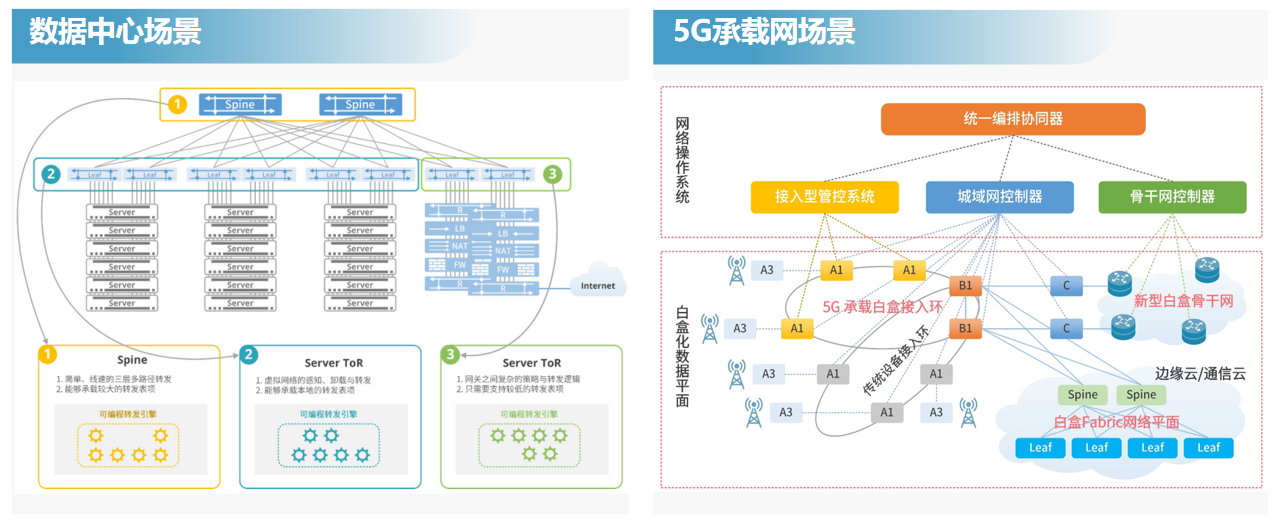
Data center scenario
Data center environments with well-defined requirements and clear network architectures are ideal for white-box switches. By deploying these switches, enterprises gain full control over their software and hardware operations, enabling the construction of cost-effective, highly reliable, high-performance, automated, and intelligent data center networks. In this context, the SR3800B-CE acts as a Spine node, providing 100GE port aggregation capabilities to establish end-to-end 100GE connectivity. Furthermore, through integration with technologies like stacking, link aggregation, VxLAN, and EVPN, it creates a non-blocking Layer 2 VxLAN Overlay network. This infrastructure ensures seamless virtual machine migration and flexible deployment of user services.
5G bearer network scenarios
The 5G bearer network emphasizes programmable, deterministic, customizable, and high-performance requirements for network protocols and functionalities, delivering dedicated line services with software/hardware slicing and QoS guarantees. White-box switches are transforming the traditional switch and router paradigms, achieving full compatibility across all scenarios from access bearer networks to next-generation backbone systems. In edge cloud/communication cloud networking, the SR3800B-CE acts as a Spine node with 100GE port aggregation capability, establishing an end-to-end 100GE full connectivity solution.

 EN
EN