Home > Products > Optical Network > DCI
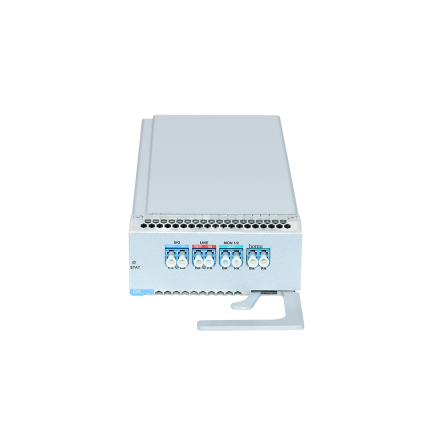
EDFA-OA is an OTM terminal optical amplification card for the STN6800-D16 platform from Sino-Telecom, which integrates a power amplifier and a preamplifier and supports bidirectional amplification. The EDFA-OA card supports C-band transmission with a transmission distance of 0~120km, and integrates optical signal wavelength and power monitoring, fiber link attenuation and break point testing, 1510nm network management monitoring channel, and intra-station and inter-station adaptive gain equalization (APR).
The power amplifier is a fixed gain amplifier, while the preamplifier is an adjustable gain amplifier.
Complete C-band signal power amplification function, and support gain adjustable function;
The laser can be turned on and off through network management settings, facilitating testing and operation and maintenance;
The board card is equipped with a VOA module, which can be used to automatically adjust the input optical power of the EDFA module.
Complete the receiving, transmitting, controlling, and processing of optical supervisory channel signals;
Realize the multiplexing and demultiplexing of the main optical channel and the optical supervisory channel;
In conjunction with the OTDR board card, it completes the online OTDR detection function, enabling the detection of the fiber status in the optical line system;
Provide an online monitoring port capable of outputting a small amount of optical signal to monitor the spectral performance of the optical signal without interrupting the service;
Support the detection and reporting of optical power;
Support the reporting of single board card alarms and performance events.
|
feature |
description |
|
slot |
Single slot/double slot |
|
project |
unit |
indicator |
||
|
BA |
PA1 |
PA2 |
||
|
number of channels |
- |
48@100GHz 96@50GHz 40@150GHz |
48@100GHz 96@50GHz 40@150GHz |
48@100GHz 96@50GHz 40@150GHz |
|
Amplifier type |
- |
EDFA |
EDFA |
EDFA |
|
Operating wavelength range |
nm |
1528~1568 1524~1572 |
1528~1568 1524~1572 |
1528~1568 1524~1572 |
|
Nominal gain |
dB |
12 |
20 |
30 |
|
Total input optical power range |
dBm |
-21~+11 |
-26~+6 |
-35~-1 |
|
Noise figure (NF) |
dB |
<8 |
<8.1@G=15 <5.8@G=20~22 <5.5@G=23~25 |
<8@G=22 <6.1@G=25 <5.5@G=28~35 |
|
Channel gain |
dB |
9~15 |
15~25 |
22~35 |
|
gain flatness |
dB |
<1.5 |
<1.5 |
<1.5 |
|
Polarization-dependent loss |
dB |
<0.5 |
<0.5 |
<0.5 |
|
Input/output reflection coefficient |
dB |
<-30 |
<-30 |
<-30 |
|
Input/output optical power detection accuracy |
dB |
±0.5 |
±0.5 |
±0.5 |
|
Output optical power stability |
dB |
±0.5 |
±0.5 |
±0.5 |
|
Wave amplification/reduction transient response time |
ms |
<1 |
<1 |
<1 |
|
Increase/decrease wave transient gain fluctuation @48 waves, drop 47 waves |
dB |
-1~+1 |
-1~+1 |
-1~+1 |
|
Gain response time |
ms |
<10 |
<10 |
<10 |
VOA
|
project |
unit |
indicator |
Remarks |
|
|
Operating wavelength |
nm |
1528~1568 1524~1572 |
|
|
|
Scope and accuracy |
dB |
|
||
|
Inherent insertion loss |
dB |
<1 |
Typical value: 0.5dB |
|
|
Wavelength-dependent loss |
dB |
<0.3 @0~8dB <0.6 @8~15dB |
|
|
|
return loss |
dB |
>40 |
|
|
|
Polarization-dependent loss |
dB |
<0.5 |
|
|
|
response time |
ms |
<200 |
||
Point-to-point application

Typical application scenarios

 EN
EN