Home > Products > IP Networks > DC Switch
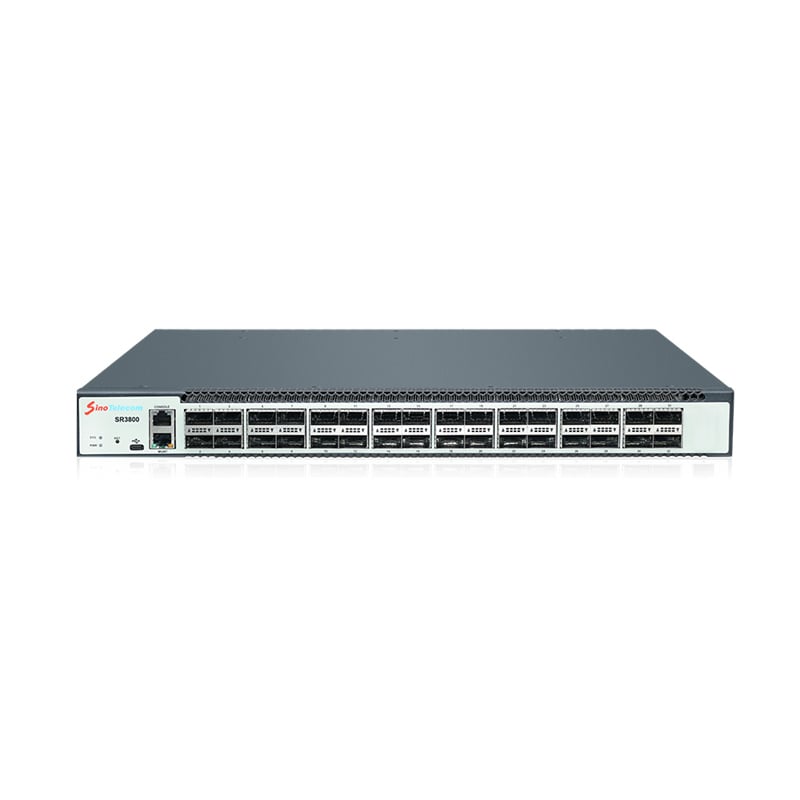
SR3800 is a next-generation high-performance, high-density 100GE aggregation switch launched by Sino for data centers.
The SR3800 is Sino's next-generation high-performance, high-density aggregation switch designed for data centers. With a total switching capacity of 6.4Tbps and 32100GE/40GE ports, it delivers robust data center features and enhanced Layer 2/3 functionalities. This solution optimally addresses the infrastructure needs of telecom operators and enterprises across industries, empowering them to build cloud-ready data center network platforms.
With an advanced hardware architecture design and industry-leading processing power, the 1U box switch delivers a high-density port configuration of 32100GE/40GE ports. Equipped with high-performance ASIC switching chips, it meets the application requirements of various complex scenarios.
To meet the requirements of non-blocking data transmission for data centers with large traffic, the system provides powerful cache capacity and supports advanced cache scheduling mechanism to ensure the effective utilization of device cache capacity.
Key system components, such as power modules and fan modules, are equipped with 1+1 backup and hot-swappable, enabling seamless failover without manual intervention.
Supports STP/RSTP/MSTP protocols, VRRP, and features redundant protection mechanisms including ring protection, dual uplink primary/backup link protection, and LACP link aggregation.
The ultra-high precision BFD bidirectional link detection mechanism, through the interaction with the second and third layer protocols, realizes millisecond fault detection and service recovery, greatly improving the reliability of the network system.
The high reliability design of hardware and software meets the millisecond-level failure recovery time requirements of telecom-grade services, and truly achieves the high reliability of 59s (99.999%) for operational-grade core equipment.
VxLAN support enables the construction of Overlay networks in data centers, addressing the limitations of traditional data center networks with insufficient VLAN numbers and scalability challenges. By leveraging Overlay technology, new subnets can be created without being constrained by physical network IP addresses or broadcast domains.
The solution supports the EVPN protocol, enabling automatic discovery and authentication of VTEP (Tunnel Endpoint). This reduces VxLAN data plane flooding and eliminates reliance on underlying multicast deployment, simplifying VxLAN deployment and improving the efficiency of large Layer 2 network construction. It better meets the deployment requirements of large Layer 2 networks within data centers.
Supports ISS (Intelligent Switch Stack) virtualization technology, which virtualizes multiple physical devices into a single logical device for unified operation and management, reducing network nodes and enhancing network reliability.
Supports M-LAG cross-device link aggregation to enable dual-active link uplinks to servers/switches, allowing link aggregation across multiple devices and improving link reliability from the board level to the device level.
The solution supports the RoCE protocol, enabling lossless Ethernet low-latency forwarding based on RDMA (Remote Direct Memory Access). This optimization significantly improves service forwarding performance, substantially reduces the per-bit cost across the network, and enhances the competitiveness of service products.
The fully developed two-and three-tier multicast routing protocol supports IPTV, multi-terminal HD video surveillance, and HD video conferencing access.
The comprehensive three-tier routing protocol and large routing table capacity meet the needs of various types of network interconnection, and can be used to build large campus networks, enterprise networks and industry user private networks.
Supports L2-L4 packet filtering and provides flow classification technology. Offers flexible queue scheduling algorithms that can be configured for both ports and queues, supporting PQ, WFQ, WRR, WRED, and other queue scheduling mechanisms, as well as congestion avoidance mechanisms like WRED and tail drop.
Full support for the IPv6 protocol suite, including IPv6 neighbor discovery, ICMPv6, Path MTU discovery, DHCPv6, and other IPv6 features.
Supports IPv6-based Ping, Traceroute, Telnet, SSH, ACL, and other protocols to meet the needs of pure IPv6 network device management and service control.
It supports IPv6 multicast features such as MLD and MLD Snooping, and IPv6 Layer 3 routing protocols including static routing, RIPng, OSPFv3, and BGP4+. The solution provides users with comprehensive IPv6 Layer 2 and Layer 3 connectivity.
Device-level security: The advanced hardware architecture enables hierarchical packet scheduling and protection, defending against DoS attacks, TCP SYN Flood, UDP Flood, broadcast storms, and high traffic. It also provides command-line access control with tiered permissions.
Comprehensive security authentication mechanism: Supports plaintext or MD5 authentication for relevant routing protocols, as well as AAA authentication (Radius/Tacacs+) to provide users with a complete security authentication mechanism.
Enhanced business security mechanism: Supports IPv4/v6 ACL access control based on standards, extensions, and VLANs, effectively controlling unauthorized services and improving network system security.
Supports multiple management interfaces including Console and MGMT ports, SNMPv1/v2/v3, and a universal network management platform. Enables device management through CLI, TELNET, and SSH with enhanced security via SSH2.0 and SSL encryption.
Supports SPAN/RSPAN mirroring and multiple mirroring observation ports. It analyzes network traffic output to take appropriate management and maintenance actions, and provides users with various network traffic analysis reports to help them optimize network structure and adjust resource deployment in a timely manner.
The advanced power system architecture design enables efficient power conversion, unique power monitoring, slow start-up and other functions, real-time monitoring of the running state of the whole machine, intelligent adjustment, deep energy saving.
Intelligent fan management system: Intelligent fan design, support automatic speed adjustment, effectively reduce the speed, reduce noise, and extend the service life of the fan.
Supports energy-efficient Ethernet features compliant with the IEEE 802.3az international standard, effectively reducing energy consumption.
|
product model |
SR3800 |
|
product size |
442mm×386mm×44mm (1U height) |
|
exchange capacity |
6.4Tbps |
|
Packet forwarding rate |
2030Mpps |
|
Port configuration |
32*100GE/40GE ports |
|
Management port |
1 MGMT port, 1 Console port |
|
MAC entry |
96000 |
|
FIBv4 entry |
16000 |
|
FIBv6 entry |
8000 |
|
ARP entry |
16000 |
|
ND entry |
8000 |
|
ACL entry |
4000 |
|
VLAN quantity |
4094 |
|
QoS queue count |
6144 |
|
VNI activity count |
2000 |
|
VxLAN tunnel count |
2000 |
|
VxLAN Gateway interface count |
4000 |
|
VxLAN and VLAN mapping table count |
8000 |
|
Data Center Features |
Supports stacking/M-LAG, VXLAN routing/bridging, BGP EVPN, RoCE |
|
L2 protocol |
IEEE802.3ae(10GBase), IEEE802.3ak, IEEE802.3an, IEEE802.3x, IEEE802.3ad (Link Aggregation), IEEE802.1p, IEEE802.1x, IEEE802.1Q, IEEE802.1D(STP), IEEE802.1w (RSTP), IEEE802.1s (MSTP), IGMP Snooping, MLD Snooping, Jumbo Frame(9Kbytes), IEEE802.1ad (QinQ) |
|
L3 protocol |
Static routing, policy-based routing, OSPF, RIP, IS-IS, BGP4, MP-BGP, ECMP, ARP, VRRP |
|
IPv6 protocol |
ND、ICMPv6、Ping/Traceroute v6、Telnet/SSH v6、NTP v6、ACLv6 |
|
IPv6 features |
Static routing, policy-based routing, OSPFv3, RIPng, BGP4+, ECMP, MLDv1/v2, PIM-SMv6 |
|
QoS |
Supports EXP priority mapping for 802.1p, DSCP, ToS, and other EXPs Supports ACL flow classification and priority marking (Mark/Remark) Supports multiple queuing scheduling mechanisms, including PQ, WFQ, and WRR Supports congestion avoidance mechanisms such as WRED and tail drop |
|
Security features |
Supports DDoS attacks, ICMP attacks, ARP attacks, and more Supports AAA authentication such as RADIUS/TACACS+ Supports IPv4/v6 ACL packet filtering based on standards, extensions, and VLANs Supports MD5 authentication for OSPF, RIPv2, and BGPv4 messages Supports Telnet login and password mechanism with restricted IP addresses, and supports user-level management Supports suppression of broadcast messages and unknown multicast group broadcast messages |
|
Manage and maintain |
SNMP v1/v2/v3, Netconf, Telnet, Console, MGMT, RMON, SSH v1/v2, FTP/TFTP file download management, NTP, Syslog, SPAN/RSPAN/ERSPAN, telemetry, fan support, power alarm, and temperature anomaly alarm |
|
working voltage |
AC:100V-240V,±10% DC:-36V~-72V HVDC:180V-300V |
|
working temperature |
0 to 50°C, with hourly changes of less than 10°C |
|
Working humidity |
10% to 90% (no condensation, no frost) |
|
above sea level |
-500~2000m |
|
Dust resistance |
≤30,000 particles/liter (when dust particles are ≥0.5μm) |
|
Seismic intensity |
≤8 degrees |
|
MTBF |
> 100,000 hours |
|
Power consumption |
440W |
|
Total weight |
8kg (includes 2 power supplies and 2 fans) |
|
Power fan |
Hot-swappable 1+1 power supply, hot-swappable 1+1 fan |
|
Green and energy-saving |
Supports IEEE 802.3az Green Energy Efficiency Ethernet |
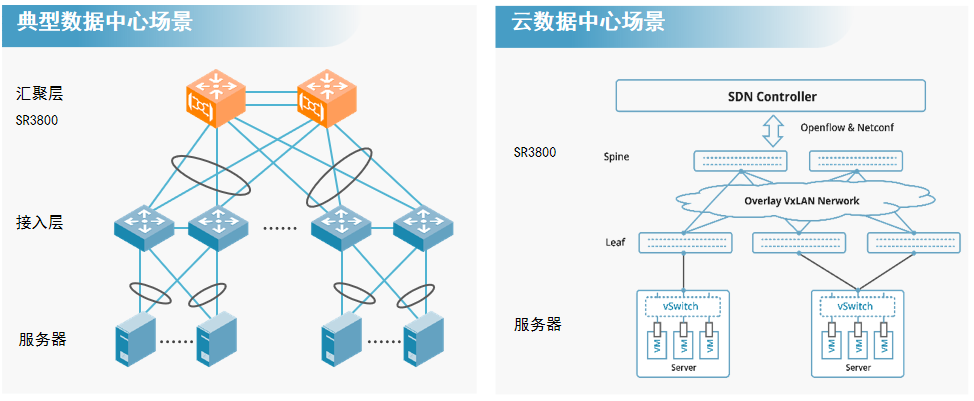
A typical data center scenario
The access layer utilizes SR3300/SR3600/SR3700 switches to deliver high-density 10GE/25GE server access solutions, while the aggregation layer employs SR3800 switches for 100GE high-bandwidth aggregation. By integrating technologies like stacking and link aggregation, the system establishes a high-performance, highly reliable, and redundant data center network.
Cloud data center scenario
The SR3300/SR3600/SR3700 serve as Leaf nodes in cloud data centers, while the SR3800 functions as Spine nodes. These devices are interconnected via 100GE ports to create a fully connected 100GE end-to-end solution. By leveraging technologies such as stacking, link aggregation, VxLAN, and EVPN, the system establishes a non-blocking Layer 2 VxLAN Overlay network, enabling large-scale virtual machine migration and flexible deployment of user services.

 EN
EN