
 EN
EN
We are experiencing a sea change in the digital world. AI workloads, cloud-native applications and edge computing have moved from conceptual stages to the production environments, driving vast amounts of data traffic between data centers. For new and up-and-coming operators the dilemma is not whether to modernize their DCI footprint but when and how. The transition from 100G to 800G and up can be complex technically and financially, but critical to competing effectively and remaining viable in the future.
Knowing When Your Network Has Hit Its Limit
It’s first crucial to know when a DCI upgrade is at the inflection point. While the most visible signal is basic network congestion and a recurring difficulty provisioning new services due to lack of bandwidth, often the indications are more subtle. The early indicators for emerging operators revolve around measures which suggest that operational efficiencies are suffering.
Look for signs of "spectral exhaustion" – a key warning sign. You keep adding 100G or 200G waves to meet demand, and the fiber itself becomes the bottleneck. With every 100G or 200G wavelength, you are burning more power and tying up another line card port. If managing these discrete wavelengths is becoming a burden, and your operating expenses is rising without a corresponding increase in capacity, then your network design is reaching the end of its useful life.
Forklift, Modular, or Hybrid — Which Upgrade Path Works
Once the decision has been made to make a change, the strategy to make the transition is critical. New entrants into the space often have three main strategic approaches to consider:
Forklift Upgrades: This is a clean sweep, in the sense that we get all the benefits of a new architecture – such as the far superior per-bit power efficiency – but usually, the total cost of entry is quite simply unachievable and, by its very nature, is also hugely disruptive. This 'big bang' strategy for a greenfield operator can take a bite out of capital budgets, and of course carry the risks of that disruption.
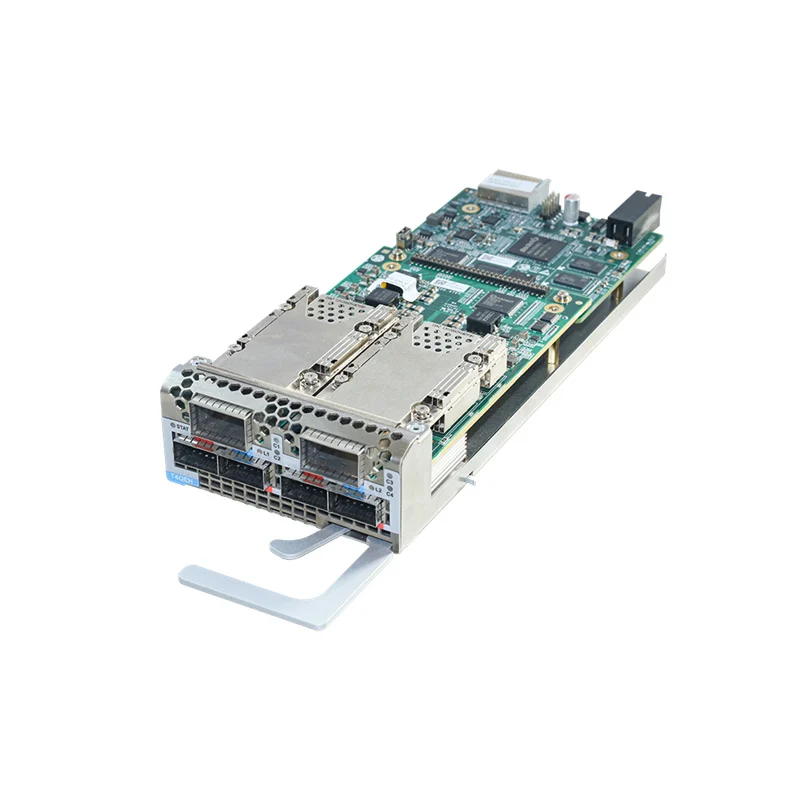
Modular Upgrades with Pluggable Line Cards: The most efficient, scalable and economical solution for network capacity expansion is a pay as you grow, modular architecture. The Sino Telecom STN6800 D16 is a slot-based family of line cards providing the physical host for the client side and line side optical modules. If the hardware or platform supports a pluggable card-based architecture, operators can add or replace cards to provide additional ports for optical modules, enabling flexible capacity expansion as network requirements grow.
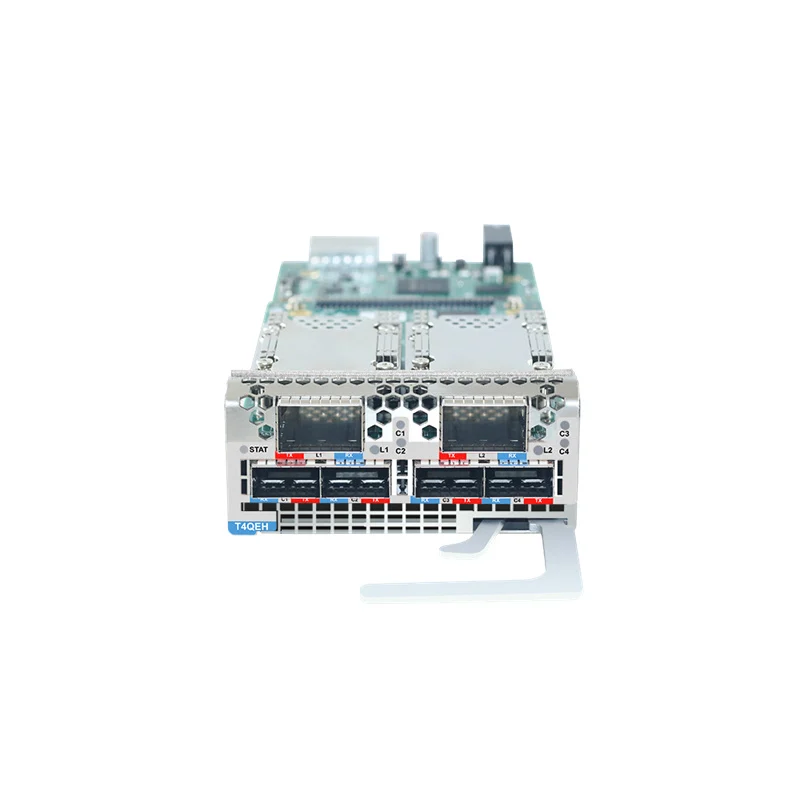
Take an instance, for an application on 100G client, currently operational, if on account of increased revenues the demand rises to a total 200G, no hardware upgrade is necessary. The operator can add a matching pluggable in the available client line port in the existing client card, or provision another card (say, T4QH for 4×100G aggregation) that can be provisioned online. Moreover, if rapidly growing services, if there is demand for a greater capacity line card, on service is migrated to the much higher density card (such as from T4QEH, say 4x400G to 800G line, to T8EH, say 8x100G /4x400G to 800G on service).
This card-based, modular architecture really allows the operator to scale their businesses from 100G to 400G and further up (to 800G) simply by adding or changing the correct coherent optical modules or line cards. This protects the initial investment and enables matching of the capacity to revenue.
Hybrid: The most practical approach for most operators involves some variation of the two described above. For instance, perform a forklift upgrade at the central aggregation point, but implement modular, plug-and-play devices at your remote sites. This would refresh the bottleneck elements gradually rather than trying to redo the whole network as a single, potentially massive, project.
Why 400G, 800G, and 1.6T Each Have Their Place
Understanding current landscape of optical speeds is crucial for future-proofing your DCI investment.
400G: 400G is the present-day sweet spot for long-haul and metro DCI. It provides a significant capacity boost over 100G with improved spectral efficiency. For many emerging operators, first logical step from congested 100G network is to consolidate traffic onto fewer 400G wavelengths, dramatically simplifying optical layer and freeing up fiber capacity.
800G: It’s the ‘next stop’ on the technology roadmap, and more particularly for dense DCI and backbone network capacity. It’s a space that is developing quickly, where you can literally double the capacity without adding to the physical dimensions of the deployed infrastructure. For those anticipating significant traffic growth from AI training or backup operations, 800G provides ample headroom to meet demand for the next three to five years.
1.6T: The goal for 1.6T is the long term play. Although 1.6T is likely still several years away, the optical modules and coherent DSPs for 1.6T are already in development. Any 800G platform purchased today should be built with a clear upgrade path to 1.6T, ensuring the network remains viable for the next decade without requiring a complete architectural overhaul.
Understanding Upgrade Cost, Power, and Operational Impact
A hardware purchase only scrapes the tip of the iceberg of the upgrade costs: Total Cost of Ownership (TCO) must also include power, cooling and operating overhead.
Cost efficiency: Higher density designs (4x400G per slot with T4QEH or 8x100G/4x400G per 2 slots with T8EH) decrease chassis, shelf, and optic count, which directly leads to lower capex per G. Commonly supported pluggables (QSFP DD112, QSFP28, CFP2 DCO) support simpler sparing and also enable lower price per component for volume purchasing.
Power optimization: All cards rely on state of the art coherent DSPs and SD FEC resulting in 800G or 400G wavelengths with low power per bit. Single-slot designs (T4QEH, T2QQH, T4QH) and tunable extended C band optics let you power over more capacity, without overprovisioning of cooling or power feeders, an important benefit in colocation environments.
Operational Simplicity: The alternative, a huge network composed of a hundreds of wavelengths, is simply too difficult to run. As new operators transition to high-speed, low-wavelength-count architectures, operations will become significantly less complicated. The most advanced platforms now have effective network control and management in place to allow automation and proactive, predictive maintenance, which keeps things off small ops teams’ plates.
Conclusion
Going from 100G to 800G isn't really just a technology change. It really opens up a business opportunity that will offer new revenues to current and new operators alike. From deploying just one 400G channel right away, or an open, coherent ring that must scale to 1.6 Tbit/s down the road, pay-as-you-grow with open, modular components are the way forward.
We here at Sino-Telecom can fulfill your migration need for cost-effective, agile DCI without added expenses, operational disruptions, or economic burden. As a globally leading DCI supplier with over 100,000 units shipped worldwide, we understand the ins and outs of real-world network migration better than anyone. Contact our people to learn more about your specific network needs. We are happy to provide you with accurate pricing, full product specifications and actual examples of how operators, such as yourself, have upgraded their DCI capacity.