
 EN
EN
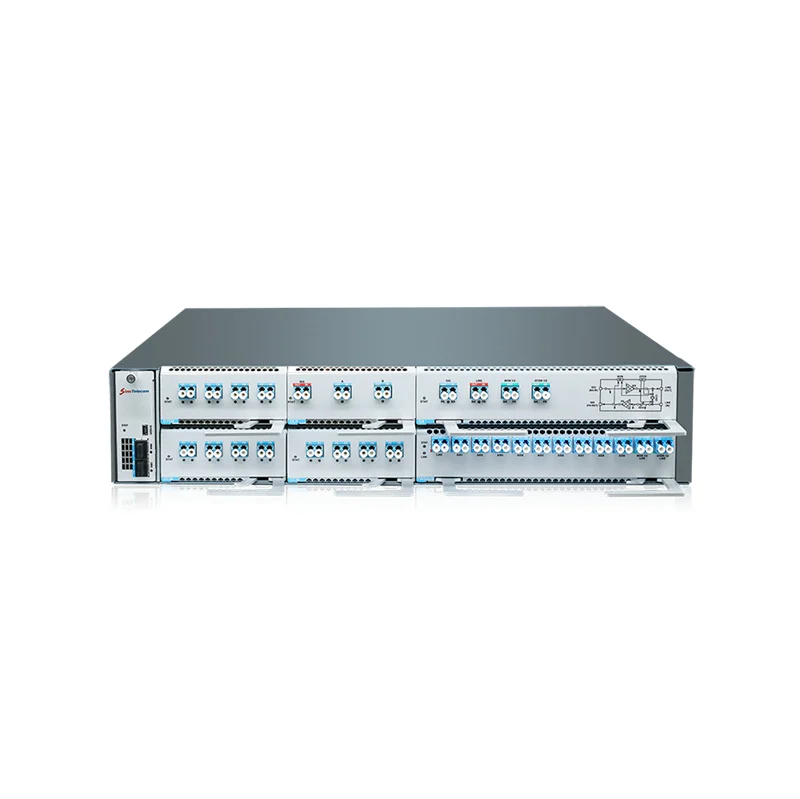
The Data Center Interconnect (DCI) market is evolving quickly. The network infrastructure architecture itself is at a crossroads: what speed should your infrastructure be? With each new workload on artificial intelligence in the cloud, the question of speed is becoming more pressing for network architects. Now the market is full of interesting choices at capacities of 400G, 800G and the newly emerging 1.6T. It is easy to pick the largest number, but that wouldn't be the ideal option, and would involve a careful consideration of technical needs, operational limitations and future objectives. As Sino-Telecom Technology Co., Inc., we offer fiber-optic solutions to enable our partners make these decisions easily and boldly.
Understanding the Differences Between 400G, 800G, and 1.6T DCI
That represents multiple generations improvement of the fiber optic transmissions. The 400G technology matures and growing very quickly. Uses 64Gbaud or 90Gbaud coherent optics, and usually over 16QAM modulation. 800G represents the next step in high-capacity optical transmission, enabled by advances in coherent optics, high-speed DSP, FEC, and optical components. It also relies on advanced digital signal processing (DSP) and forward error correction (FEC) technologies to increase capacity per wavelength while maintaining an appropriate balance between transmission performance and reach. At the cutting edge of 1.6T, many optoelectronic advances need to be developed, for example, 200Gbaud class optics are leveraged and multi wavelength are used for aggregation. 800G and 1.6T increase band width and require other type of lasers and faster DSP and FEC at a longer reach.
Choosing Based on Distance, Fiber Condition, and Traffic Demand
Not all DCI links are of same quality. The locations of a 10km metro link and a 500km regional route are very different. For shorter distances, 800G and even 1.6T can be used efficiently and most of the time keep the reach by switching to higher order modulation. In the case of long distance, however, the optical signal-to-noise ratio (OSNR) decreases, leading to a need for the modem to reduce the modulation order (and consequently the effective capacity per wavelength). Some 800G coherent solutions can operate at lower line rates, such as 400G or other intermediate rates, when longer transmission reach is required. The achievable rate depends on the specific optical implementation and link conditions. The 400G transceiver, on the other hand, can maintain its maximum specified speed for longer distances.Fiber condition is also an important factor. Fiber attenuation, chromatic dispersion, polarization effects, nonlinear impairments, and amplifier noise can all affect the achievable capacity and transmission reach of high-speed optical systems. For annual traffic growth of 30%, an 800G path may suffice; for higher growth, 1.6T may be necessary.
Comparing Cost, Power Consumption, and Efficiency
Each capacity has its own business case, depending on TCO. Optics with higher speeds are often a better value per bit. Because they have fewer ports, fibers and rack space, 800G and 1.6T transceivers aim to reduce the cost per gigabit transmitted. But the up-front price tags for these new speeds are very high. Moreover, the speed is not proportional to watt usage—800G can provide twice the nominal line rate of 400G, while some implementations can achieve improved throughput-per-watt efficiency, this results in better gbps/watt efficiency. On the other hand, which can increase operating costs. If the power is available, 800G or 1.6T could be the optimal investment in the long-term for greenfield deployments. The experience of 400G could provide a more predictable path for operation where power and cooling resources are limited in brownfields.
When 400G Is Still the Right Choice
While 400G can certainly be considered a cutting-edge technology, it is also a very relevant and strategic option. First, its maturity ensures interoperability with multiple line systems and third party equipment. Secondly, the 400G coherent optics supply chain is mature and provides stable pricing and availability, which is important for operators who can't afford the deployment delays. Thirdly, the traffic requirements aren't really high enough for 800G or 1.6T at this time, for many mid-sized operators, if not some large ones. With multi-wavelength solutions (such as 4x400G on a single fiber using DWDM) 400G is sufficient for most DCI applications. Lastly, 400G may become the optimum solution for long-haul transmission applications when attenuation in the fiber and the noise introduced by amplifiers would otherwise limit the capability of faster optics. In these cases, however, 400G isn't a tradeoff, it's the most technically appropriate choice.
Planning Your Migration Path Toward 800G and 1.6T
So no matter which 400G architecture you select today, you need to plan for 800G and 1.6T tomorrow. It starts with a 400G transceiver that supports next-generation pluggable optics and can be software-upgraded to evolve into an optics-only module over time. Moreover, a flexible line system like C-band and L-band fiber line system ensures that the fiber system is able to accommodate higher channel counts and baud rates. Another critical part of designing a migration strategy involves taking a phased approach - test out the 800G or 1.6T on a few dark fibers or in critical links where it's the biggest requirement and use the 400G for some of the less resource-intensive links. All that entails is that we're bringing those skillsets into your team without any network risk. As the standard evolves and matures, we will see a much wider availability of 800G and 1.6T solutions, which will help further reduce both the technical risks and the unit prices. The important factor will be to establish a network system that is flexible to the introduction of new optics without involving a full-forklift upgrade of the line system and chassis.
We make it possible with an expansive optical transceiver portfolio and DCI platform to get you the right capacity today, and the right capacity for when you need it.
Conclusion
Deciding between 400G, 800G, and 1.6T for your Data Center Interconnect (DCI) network has more to do with balancing capacity and distance, fiber availability and condition, traffic projection, power limitations, and cost, and we help you make the optimal choice: a proven 400G for long haul deployment where stability reigns supreme, jump straight to 800G for unparalleled power (and therefore operational cost) efficiency in terms of gbps/watt, or future-proof your infrastructure at 1.6T when densities become ultra-critical in spaces like financial exchanges, all of this on a proven migration road-map designed to avoid disruptive forklift upgrades that kill agility and productivity, as a globally leading DCI supplier with over 100,000 units already shipped worldwide by the world’s most forward-thinking providers and by adopting Sino Telecom, an agile technology leader in coherent transceivers, modular OTN platforms, and open management system helping you make the right decision for now, while enabling 800G/1.6T ready for the future. Reach out to Sino Telecom's sales team now experience illuminate the path for your next DCI evolution. Please contact our sales team for custom configuration, datasheets, successful case studies and best practices.