As the education industry continues to advance toward high bandwidth, low latency, and high reliability, traditional network architectures increasingly struggle to support multi-campus collaboration, data security, and AI research needs. To address these challenges,
Sino-Telecom leverages
DCI,
OTN, and
FTTx technologies to build an all-optical network solution covering interconnection, disaster recovery, computing collaboration, and local access.
Scenario 1: High-Speed Multi-Campus Interconnection — Unified Educational Resource Pool
For universities, K-12 education groups, and vocational education campuses with multiple locations, common challenges include high latency when accessing library and administrative systems across campuses, unstable video conferencing and remote teaching experiences, and limited fiber resources that make network expansion difficult.
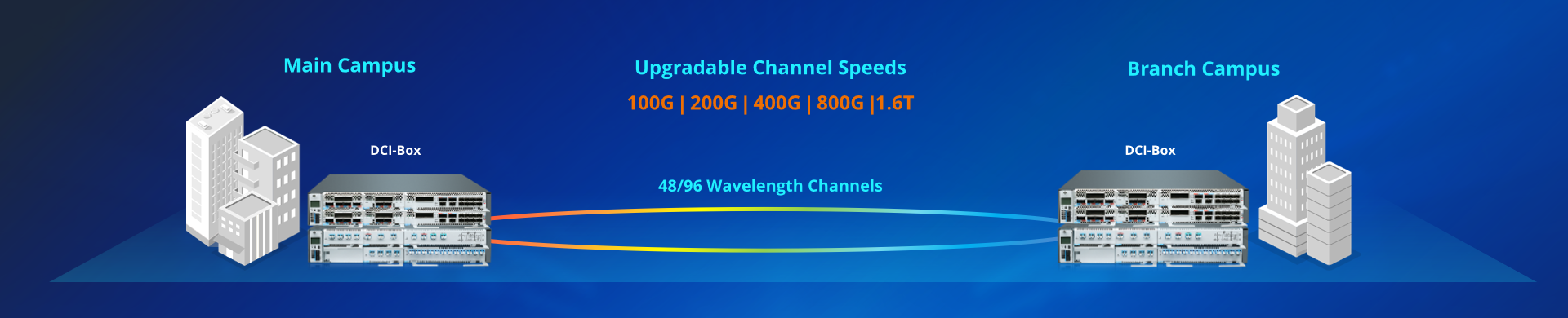
All-Optical Metro Interconnection Based on DCI-BOX
This solution uses the Sino-Telecom
DCI platform. Wave division multiplexing (DWDM) devices are deployed at the main and branch campuses, enabling 48/96 wavelength channels on a single or dual fiber, with each channel upgradeable to 100G, 200G, 400G, 800G, or 1.6T to meet future bandwidth growth requirements.
Business Isolation and Fine-Grained Scheduling: Different services are assigned independent wavelengths for physical isolation, forming natural hard pipes to avoid interference. Combined with OTN-layer ODUk/VC cross-connect technology, fine-grained bandwidth scheduling and high-reliability service delivery are ensured.
High-Reliability Protection: The system supports optical layer 1+1 protection and OCH protection, enabling millisecond-level automatic switchover in case of link or device failures to ensure uninterrupted service.
Easy Expansion and Unified Management: The DCI platform supports modular expansion and stacking, allowing total capacity to scale smoothly up to 1.6T per wavelength, while SDN controllers provide unified scheduling and centralized management across multi-vendor equipment.
Customer Value:
-
Bandwidth upgraded from gigabit to 100G/400G/800G/1.6T to meet 5–10 year growth requirements
-
Significantly reduced cross-campus latency, improving remote teaching and collaboration
-
Unified outbound and centralized operations, enhancing management efficiency
Scenario 2: Remote Disaster Recovery — "Double Insurance" for Educational Data Security
For provincial education data centers, universities, and vocational schools, insufficient remote disaster recovery presents a major risk for critical data and systems. Traditional backup approaches often cannot meet recovery speed and reliability requirements.
Dual-Active Disaster Recovery Based on OTN Hard Pipes
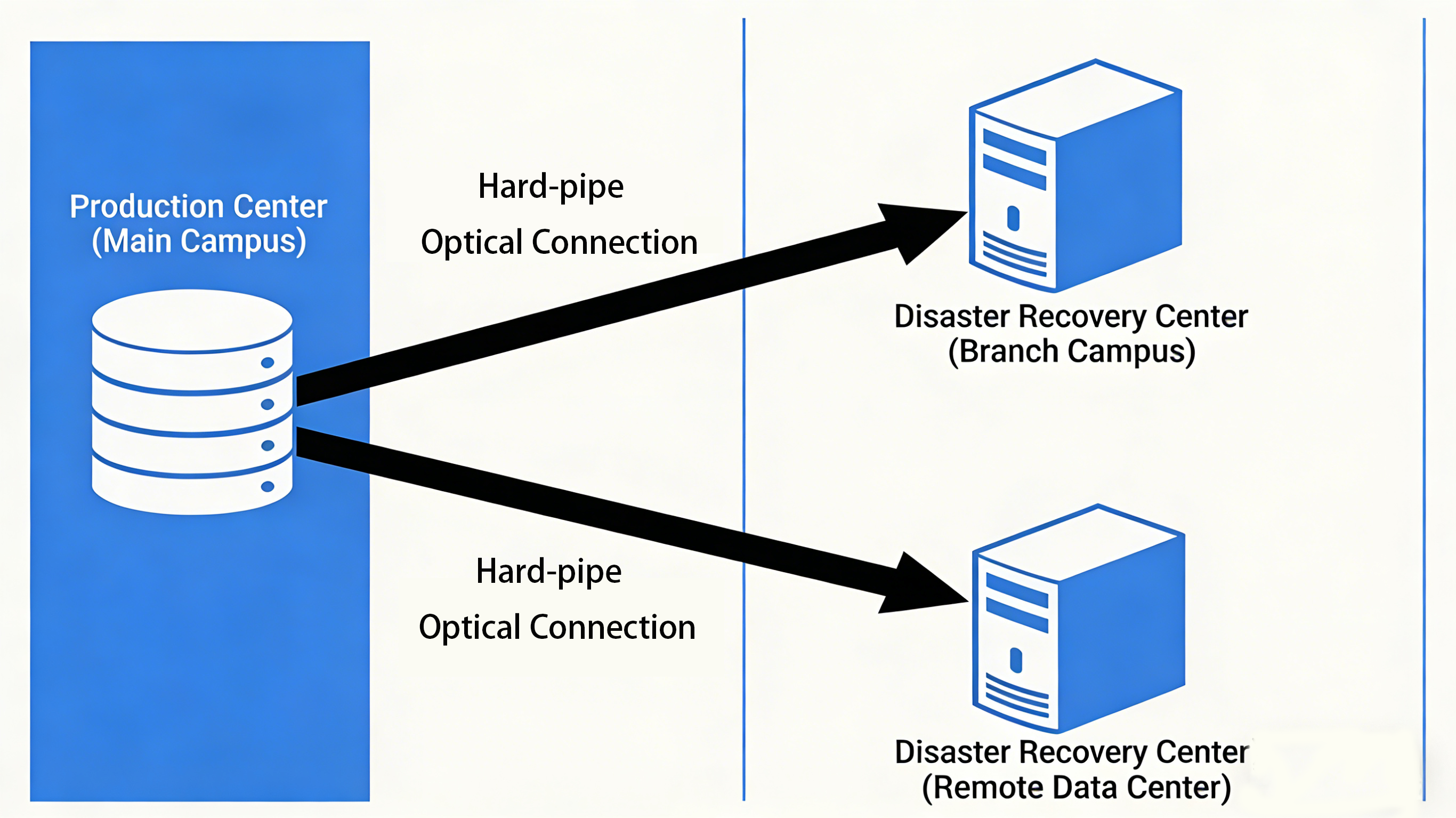
This solution employs Sino-Telecom access-type
OTN devices (card-based or box-based) together with a DCI wave division platform. A high-reliability hard-pipe optical connection is established between the production center (main campus) and the disaster recovery center (branch campus or remote data center).
Data-Level and Application-Level Disaster Recovery: Supports real-time database transaction replication (RPO≈0) and rapid recovery of critical business systems at the disaster center with RTO under 30 minutes, ensuring continuity of core services.
Automatic Protection and Switchover: In case of main center failure, services automatically switch via optical layer protection or SDN controller, reducing manual intervention and improving failover efficiency.
Flexible Access and Unified Service Aggregation: Branch campuses can connect through access-type OTN devices (supporting FE/GE/STM-1/4/16/64 interfaces) and aggregate services to the wave division platform, enabling centralized multi-service delivery and scheduling.
Customer Value:
-
Meets regulatory requirements for critical data remote backup
-
Construction costs reduced by 30–40% compared to building dedicated fiber; deployment time shortened from several months to 2 weeks
-
Critical services such as campus card, administrative, and student systems achieve near-instant data protection
Scenario 3: Cross-Campus Supercomputing Collaboration — Compute Network Foundation
For research universities, institutes, and AI training bases, rapidly growing demands for large model training and high-performance computing exceed single-campus resources. Cross-campus computing faces latency and packet loss challenges, affecting distributed AI training efficiency.
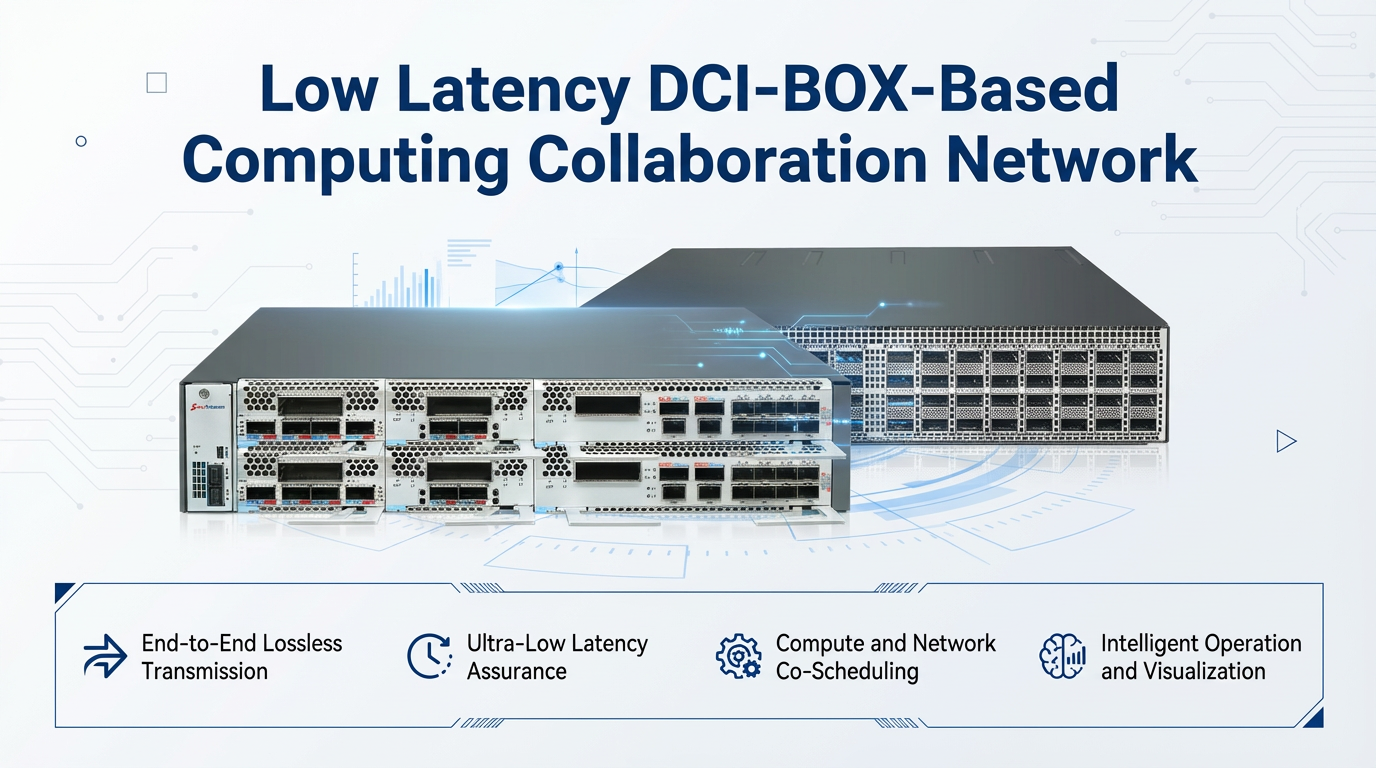
Low Latency DCI-BOX-Based Computing Collaboration Network
This solution uses Sino-Telecom DCI-BOX wave division devices and
RoCE lossless AI switches to build cross-data-center computing networks. Multiple supercomputing centers are interconnected via DCI-BOX full-optical links with ROADM/FOADM ring topology for flexible wavelength scheduling. Within each data center, RoCE lossless switches construct high-performance computing (HPC) and AI training clusters, connected to the DCI platform via 100G/400G high-speed interfaces, achieving seamless cross-data-center compute interconnection.
End-to-End Lossless Transmission: RoCE switches utilize PFC (Priority Flow Control) and ECN (Explicit Congestion Notification) to enable lossless RDMA communication. Combined with DCI-BOX ODUk hard pipes and FEC optimization, an end-to-end lossless path is established across data centers, eliminating packet loss impact on distributed AI training.
Ultra-Low Latency Assurance: RoCE switches provide nanosecond-level port latency, and DCI devices achieve sub-5μs single-node forwarding, meeting microsecond-level synchronization requirements for distributed AI training. NMS system monitors OSNR and performs dynamic optimization to ensure transmission quality.
Compute and Network Co-Scheduling: SDN controllers coordinate RoCE networks with DCI optical networks. Task schedulers like Slurm dynamically adjust network priorities and wavelength allocation based on workload, optimizing cross-data-center compute resource utilization.
Intelligent Operation and Visualization: NMS provides optical performance monitoring, OSNR measurement (±1dB), automatic fault diagnosis, and performance degradation alerts, reducing troubleshooting time from hours to minutes, and enabling unified management of data center and wide-area networks.
Customer Value:
-
Improves GPU and compute resource utilization, reducing training wait time
-
Enables unified cross-campus compute scheduling and resource pooling
-
Minimizes network packet loss and latency impact on AI performance
-
Supports future bandwidth expansion and larger-scale compute clusters
Scenario 4: FTTx Campus Access Network — Flexible and Efficient
For universities, K-12 schools, and smart campus deployments, traditional three-tier (core-aggregation-access) campus networks often suffer from complex cabling, high construction cost, difficult management, and bandwidth upgrade limitations, hindering smart campus and IoT development.
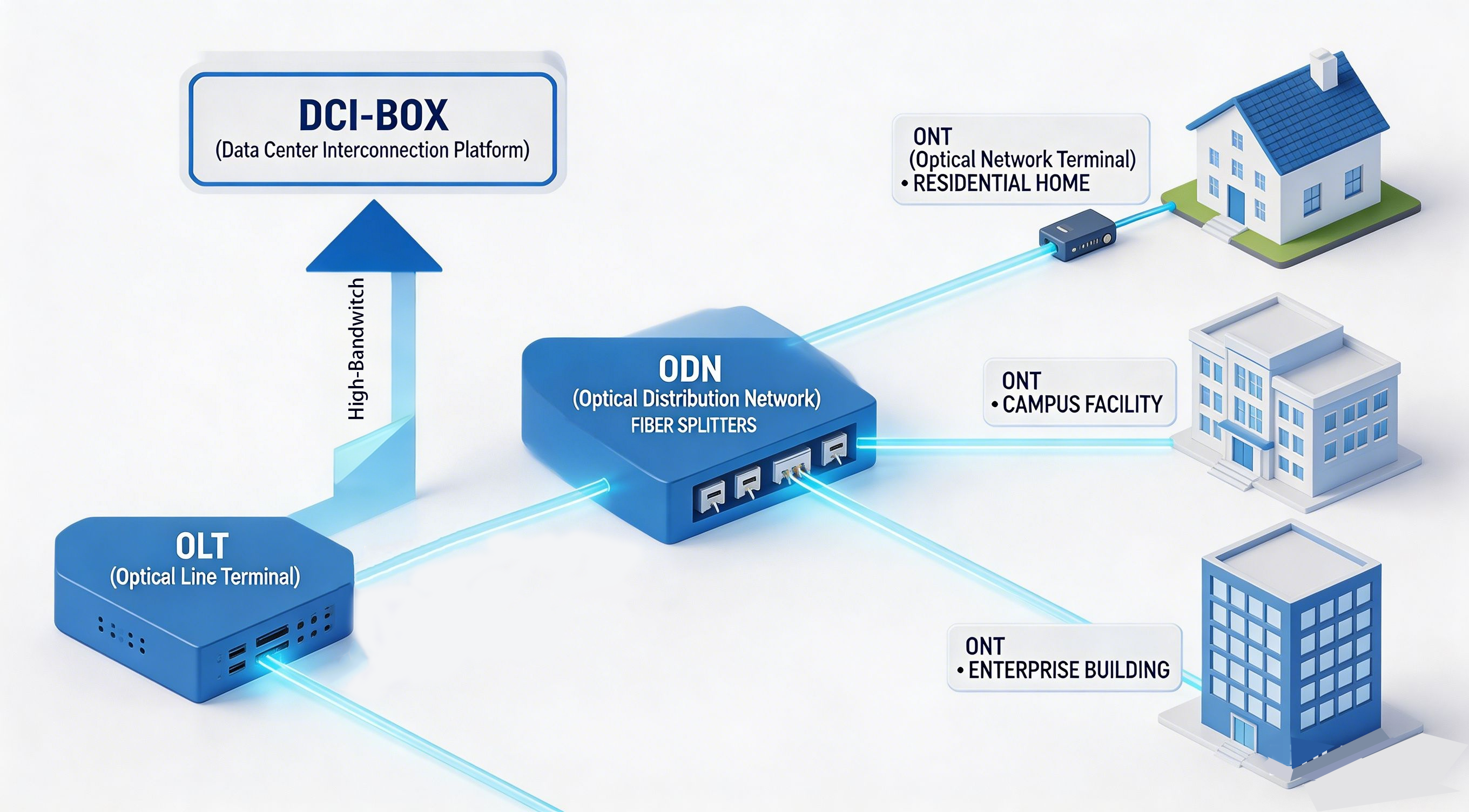
This solution employs Sino-Telecom
FTTx products with seamless Combo GPON evolution. Using OLT, ODN, and ONT devices, it builds a simple, flexible access network supporting multiple terminals and devices, which can be uplinked to the DCI-BOX platform to achieve higher bandwidth and lower latency.
Customer Value:
-
Reduces construction costs and the number of devices
-
Lowers operation and maintenance costs through centralized management and passive network design
-
Provides higher bandwidth access
-
Supports smart campus applications
-
Extends network lifecycle
By integrating DCI, OTN, and FTTx technologies into a unified all-optical architecture,
Sino-Telecom provides a scalable and future-ready foundation for education networks. From high-speed interconnection and reliable disaster recovery to compute-network collaboration and simplified campus access, the solution systematically addresses the evolving demands of digital education.


 EN
EN