
 EN
EN
There’s a data center interconnection (DCI) transformation in progress. AI’s rapidly growing influence is the main driver. What was once sufficient is no longer applicable for today’s AI applications workloads – driving need for the next generation of high-capacity, low-latency optical network. The use of AI has driven and accelerated the evolution of traffic.
How AI Workloads Are Reshaping Data Center Traffic
Indeed, industry figures show the volume of optical equipment will increase by 40% between 2021 and 2025, then by a further 40% in 2026¹. The signal is loud and clear, more and more fibre network investment resources are being dedicated by cloud, hyperscalers and enterprise cloud providers than telecom operators. Redundancy layering is not a new concept, but as organisations move from scaling up a single data centre to scaling to geographically-distributed data centres, DCI is now an important part of AI infrastructure.
Why 400G Became the Foundation of Modern DCI
As interconnect service demand grew alongside AI workloads, the need for a more scalable, reliable solution led operators to adopt 400G as the new DCI benchmark. 400G systems were able to offer immediate capacity relief and were also laying the foundation for future capacity upgrades. As operators strive to rapidly scale and meet the growing demands for AI traffic, today 400G is the default for inter-data-center connectivity.
The Transition to 800G: Capacity, Distance, and Efficiency Improvements
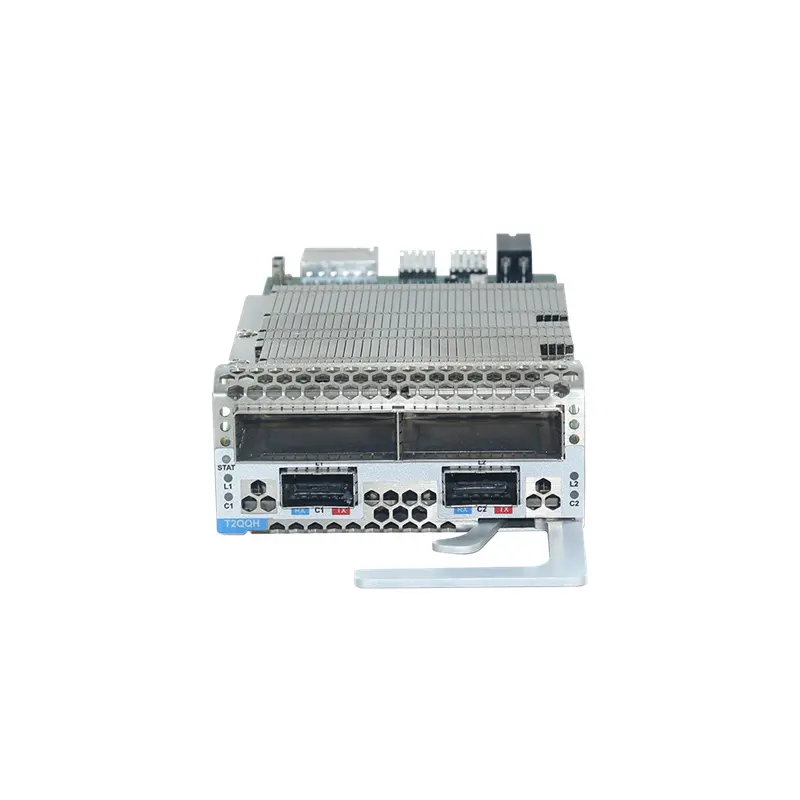
The industry is quickly advancing towards 800G optical transport as workloads grow thanks to AI. 800G delivers twice the bandwidth of 400G (800 Gbps) in the same physical size, to meet the growing bandwidth requirements of distributed AI training and inference. Not only is it an improvement in speed, but it's a general overall efficiency improvement. To achieve increased spectral efficiency, extended reach and lower power per bit, modern 800G systems take advantage of state-of-the-art coherent DSP technology and silicon photonics. For operators with several thousand links between sites who are looking to ramp up their network but don't want to do so with an increase in space and energy consumption, 800G is an attractive choice. The STN6800-D16 series is available in two platform form factors: 1U with 6.4T total capacity and 2U with 12.8T total capacity. Each port supports up to 800G, with readiness for 1.6T per port, addressing the demanding requirements of the AI era. Flexible per-port transport options include 200G, 400G, and 800G.
Preparing for 1.6T: The Next Generation of Optical Interconnect
The industry is already preparing for 1.6T optical interconnects. AI traffic is expected to increase by about 23% annually, with intra-data-center traffic growing at 65% per year. Operations will be able to future proof their DCI infrastructure to be able to deploy next generation AI clusters and ultra-high bandwidth applications. As the industry moves toward 1.6T, DCI capacity and efficiency will be further enhanced with 200G per lane technology. Forward-thinking operators are investing in flexible, modular platforms that support a clear upgrade path to 1.6T without requiring forklift upgrades.
Designing a Future-Proof DCI Architecture for AI Growth
Several design and planning principles are crucial when creating a DCI architecture capable of spurring the growth of AI. First, modularity is critical – with a mix and match line cards and transceivers, an operator can add capacity when they want. Second, it is important to be open – the ease of integration with the existing network management and orchestration tools through standard open interfaces (such as SNMP, NETCONF) would make it easier. Third, power efficiency and density are increasingly important – as space and power constraints become key factors in network design decisions. Sino-Telecom's DCI solutions are based on these principles with reduced size, stackable platforms and provide ultra-large transmission capacity while saving power, and operating complexity.
Conclusion
The evolution of data center networking for the age of AI is far from over, and continues to progress from 400G to 800G, with 1.6T on the horizon. In the digital economy, DCI has become a critical topic as evolving traffic patterns and the need for greater connectivity between facilities continue to grow.
With 18 years of experience in delivering optical networking solutions, Sino-Telecom Technology Co., Inc. is a global top-tier DCI supplier, have delivered more than 100,000 units globally. We are the technological leader in patent number: 241 patents and 156 software copyrights. The ultra-high bandwidth, flexibility and efficiency of our STN6800-D16 series modular DCI OTN platforms are perfect for constructing DCI networks that are ready for AI, capable of scaling from 400G to 800G today, with a clear upgrade path to 1.6T and beyond.
Looking to start laying the groundwork for a DCI future ready with AI? To get an idea of how much a solution will cost today, please call us! Sino-Telecom can provide you with solutions and services that allow deployment of high capacity, intelligence to your DCI network to support your AI workload.